
Opinion
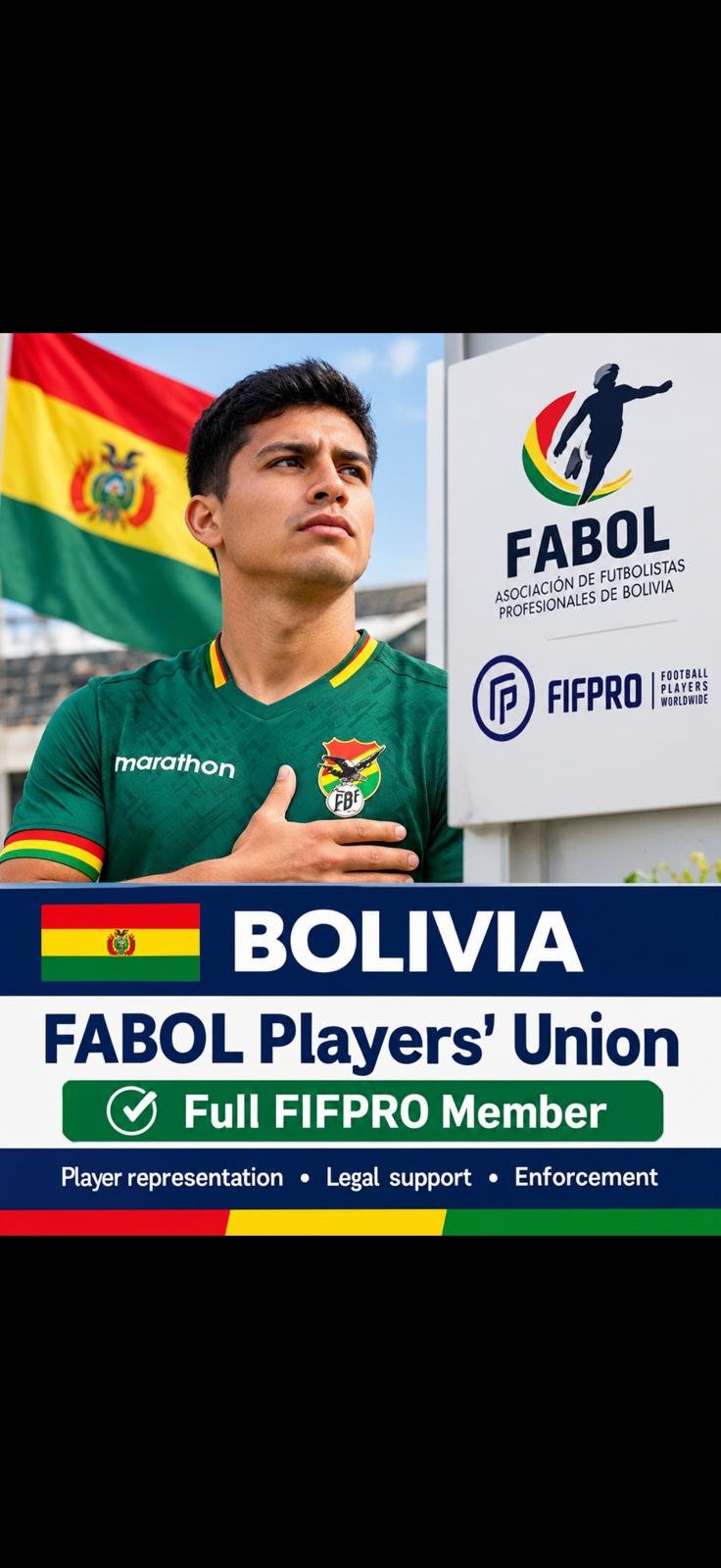
Bolivia: The Price of Non-FIFPRO Membership — When Winning The Case Was Not Enough, FIFPRO And FABOL Fought Until The Player Was Paid

By Paul Lucky Okoku


A footballer can win a case and still lose.
He can have a contract.
He can prove that money is owed.
He can obtain a favourable judgment.
He can even win before the Court of Arbitration for Sport.
But if the decision is not enforced, what exactly has he won?
That is the lesson from the case of Bolivian midfielder Cristian Paul Arano Ruiz.
His dispute with Club Blooming began over money owed from the 2022 season. What followed became a multi-year battle involving Bolivia’s football judicial system, the Court of Arbitration for Sport, FABOL, FIFPRO and eventually FIFA’s disciplinary machinery.

By June 2026, Arano finally received the money owed to him.
The case shows what organised player representation can mean when a footballer has already won on paper but still needs somebody to make that victory real.
THE DEBT WAS USD $42,200
According to FIFPRO, Arano claimed USD $42,200 in unpaid salaries, bonuses and performance-related payments from Club Blooming.
With the support of FABOL — Bolivia’s professional footballers’ union — he filed a claim before the Bolivian Football Federation’s Dispute Resolution Tribunal in February 2023.
The tribunal ruled in his favour.
Blooming appealed.
The federation’s High Court of Appeal later ruled that the football tribunal did not have jurisdiction over bonuses and incentive payments, reducing what Arano could recover through football justice to USD $24,000, representing three unpaid salaries.
The remaining contractual payments would have to be pursued elsewhere.
For Arano, that meant more delay and uncertainty.
For other players, it could have created a dangerous precedent.
That was when FABOL and FIFPRO took the matter beyond Bolivia.
FROM BOLIVIA TO CAS
In October 2024, FABOL and FIFPRO appealed to the Court of Arbitration for Sport, CAS.
In May 2025, CAS ruled in Arano’s favour.
The Bolivian appeal decision was annulled.
Blooming was ordered to pay the full amount claimed, together with five percent interest dating from September 2023.
CAS also confirmed that Bolivia’s football dispute-resolution tribunal had jurisdiction over contractually agreed bonuses and prizes.
That made the decision important not only for Arano, but for other Bolivian footballers facing similar disputes.
But there was still a problem.
Arano had won.
He still had not been paid.
WINNING WAS NOT ENOUGH
This is where the Bolivia case becomes especially important.
There is a difference between obtaining a judgment and enforcing one.

A judgment says what should happen.
Enforcement makes it happen.
Despite the CAS ruling, FIFPRO reported that Blooming had not complied and that the Bolivian Football Federation had failed to enforce the decision.
FABOL and FIFPRO did not stop.
They brought the matter before the FIFA Disciplinary Committee.
On November 21, 2025, FIFA found the Bolivian federation responsible for failing to execute the CAS ruling and gave it 30 days to resolve the matter.
When the situation remained unresolved, FIFA escalated the pressure.
According to FIFPRO, FIFA withheld 20 percent of a FIFA Forward Programme payment due to the Bolivian federation and warned that another 20 percent could also be withheld if the failure continued.
Now the dispute had moved beyond one player and one club.
The national federation itself faced consequences for failing to ensure that a binding football judgment was respected.
That is enforcement.
And that is where representation proved its value.
THE PLAYER WAS FINALLY PAID
On June 9, 2026, FIFPRO announced that Club Blooming had settled the debt and that Arano had recovered the salaries, bonuses and other compensation owed to him since 2022.

The Bolivian federation was also required to pay a FIFA fine.
A favourable legal ruling did not put money into the player’s account. Representation and enforcement were still required after the legal arguments had been won.
FABOL DID NOT JUST HAVE A NAME. IT ACTED.
FABOL is the Bolivian players’ union recognised by FIFPRO.
Its role in this case was practical.
It supported Arano’s original claim.
When the domestic appeal process went against part of his claim, FABOL and FIFPRO took the matter to CAS.
When CAS ruled for the player but payment still did not follow, they pursued enforcement through FIFA.
That is a chain of representation:
National union.
International union.
International arbitration.
FIFA enforcement.
The player did not have to fight every level alone.
That is why FIFPRO membership matters.
It is not simply a name or a badge.
It connects a national players’ union to a broader international system of legal expertise, advocacy and institutional pressure.
BOLIVIA’S PROBLEM WAS BIGGER THAN ONE PLAYER
Arano’s case did not occur in isolation.
In August 2024, FIFPRO reported serious concerns about player conditions in Bolivia, including unpaid salaries, contractual breaches and weaknesses in dispute-resolution structures.
At the time, FIFPRO said only one of Bolivia’s 16 professional clubs was fully current with player payments, while the other 15 owed at least two months of wages. Some historical debts reportedly extended much further.
One successful case cannot solve every structural problem in Bolivian football.
But it can establish a precedent, clarify players’ rights, demonstrate that binding decisions must be respected and show other footballers that they do not necessarily have to stand alone.
WHAT FIFPRO MEMBERSHIP ADDED
The effectiveness of player representation should ultimately be measured by what it delivers to the footballer.
Can it help players understand and protect their contracts?
Can it provide legal support when salaries are unpaid?
Can it represent players when domestic processes fail?
Can it connect them to wider international mechanisms when necessary?
In Bolivia, Cristian Arano’s case provides a practical answer.
His national players’ union supported him. FIFPRO helped take the dispute beyond the domestic system. CAS restored his full contractual claim.
When the award was still not honoured, the matter reached FIFA’s disciplinary machinery and financial pressure followed.
Eventually, the player was paid.
That does not mean every FIFPRO-supported player will win every dispute, that every unpaid salary will automatically be recovered, or that players without a FIFPRO-affiliated national union have no rights under football regulations.
It demonstrates something more specific:
Organised representation gives the individual footballer another layer of support when a dispute becomes too large, too complicated or too prolonged to fight alone.
THE PAPER MUST BECOME PAYMENT
Football is full of documents.
Contracts.
Tribunal decisions.
Appeal rulings.
Arbitration awards.
But a footballer cannot feed his family with a judgment.
He cannot pay his bills with a favourable ruling.
At some point, the paper must become payment.
Cristian Arano had the contract.
He had the claim.
He had the ruling.
He had the CAS judgment.
Still, he needed enforcement.
FABOL stayed.
FIFPRO stayed.
FIFA eventually acted.
And the player was paid.
Recognition opens the door.
Representation puts someone in the room.
Legal support wins the case.
Enforcement turns the judgment into reality.
And in Bolivia, the fight did not end when Cristian Arano won.
It ended when Cristian Arano was paid.