
World News
Lee Says South Korea Capable of Reclaiming Wartime Command of US-South Korean Forces

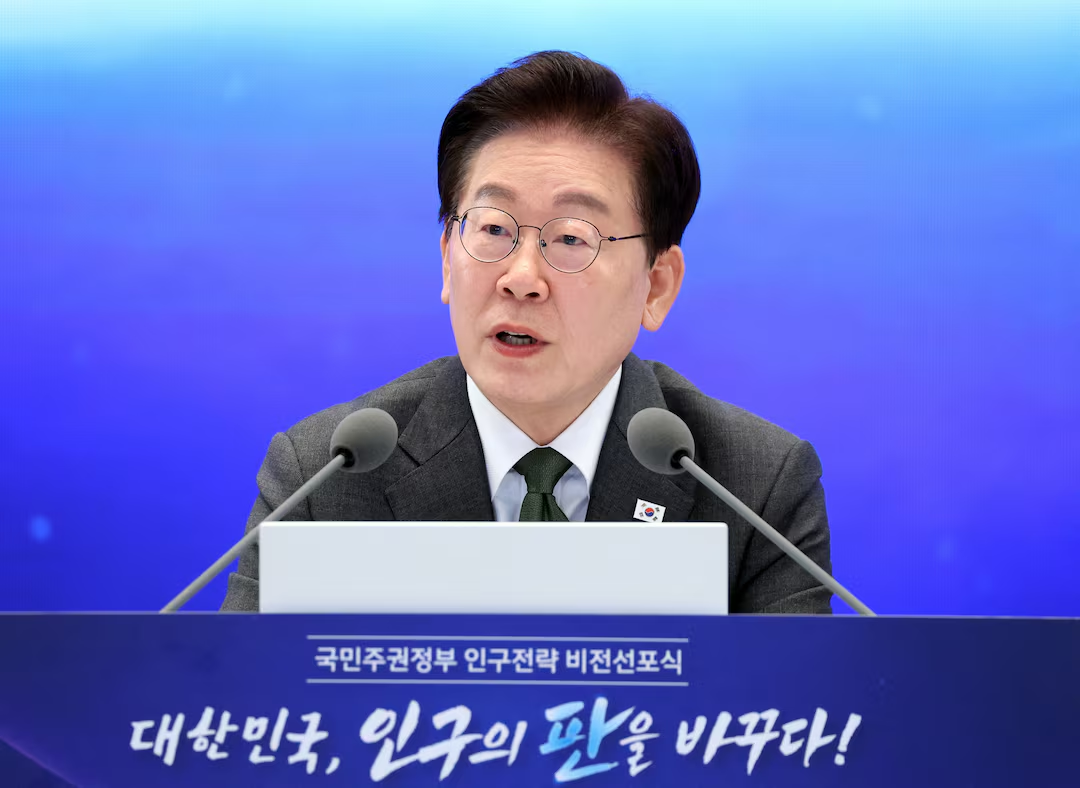
South Korean President Lee Jae Myung has declared that his country is fully capable of taking back wartime operational control of its combined forces with the United States, renewing his administration’s push for greater military autonomy.
Lee made the remarks on Monday, October 19, while speaking to reporters at the presidential compound in Seoul. He said discussions with Washington were generally progressing well and argued that South Korea should assume greater responsibility for its own defence.
“To put it plainly, we should take back wartime operational control at an early time,” Lee said, expressing confidence in the country’s military capabilities despite North Korea’s development of nuclear weapons.
The proposed change concerns wartime operational control, commonly known as OPCON, under which a US general currently leads the Combined Forces Command responsible for coordinating allied military operations during a war. South Korea commands its own forces during peacetime, but the wartime arrangement has remained in place for decades.
The existing command structure dates back to the 1950–1953 Korean War, when South Korea entrusted operational control to the United States as international forces intervened to defend the country. The two allies agreed in 2007 to pursue the eventual transfer of wartime command to South Korea.
Lee has made reclaiming OPCON a major defence and sovereignty objective, aiming to complete the process before his presidential term ends in 2030. South Korean media have reported that Seoul favours 2028 as a target, while the US military has outlined a roadmap that could see the necessary conditions met by early 2029.
However, the transition remains subject to assessments of South Korea’s military readiness and its ability to lead combined operations. Differences have emerged over the criteria required for the handover, with US Forces Korea Commander General Xavier Brunson recently saying changes in the security environment and operational plans had resulted in new standards that must be met.
South Korean officials have expressed concern that repeatedly changing the requirements could delay the process indefinitely. The government has nevertheless maintained that both countries remain committed to a conditions-based transition.
Lee argued that South Korea possesses the military and economic strength required to take on greater responsibility. He also pointed to the country’s defence spending and ongoing efforts to modernise its armed forces as evidence of its capacity to counter threats from North Korea.
The United States maintains approximately 28,500 troops in South Korea as part of the alliance’s deterrence posture against Pyongyang, which continues to develop nuclear weapons and ballistic missiles. The two Koreas remain technically at war because the 1953 conflict ended with an armistice rather than a peace treaty.
If implemented, the planned change would put a South Korean general in charge of the combined allied command during wartime, while the two countries would continue cooperating on their joint defence. The transition would mark a significant shift in military leadership, but it would not automatically end the US military presence in South Korea or dissolve the alliance.
The timing and final requirements for the handover remain unresolved as Seoul and Washington continue discussions over military readiness and the evolving regional security situation.