
Disaster/Tragedy
Death Toll Rises to 68 After Deadly Train Collision Near Toledo

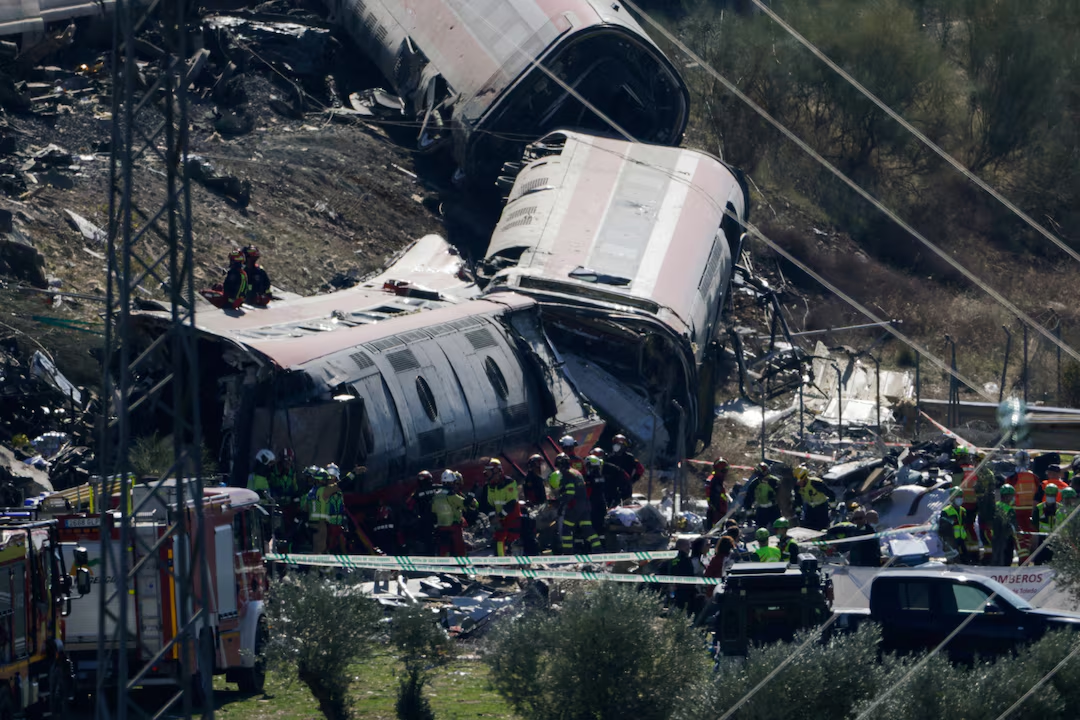
At least 68 people have been killed and dozens injured after two high-speed trains collided in central Spain, prompting a major rescue operation and an investigation into the circumstances surrounding the country’s second deadly rail disaster this year.
The collision occurred on Wednesday morning, October 28, near Urda in the province of Toledo, along the high-speed railway route connecting Madrid with Seville in southern Spain. Emergency workers continued searching damaged carriages for victims as authorities assessed the full extent of the disaster.

According to the Associated Press, the regional government of Castilla-La Mancha confirmed the death toll and said 58 people required medical treatment in hospitals. The number of casualties could change as recovery operations continue.
The accident involved a high-speed train operated by Spain’s state-owned Renfe and another operated by private company Iryo. Authorities said the Renfe train struck the rear of the Iryo train, which had stopped on the tracks, causing carriages to derail. Some of the damaged carriages fell down an embankment, leaving twisted metal and debris scattered around the crash site.
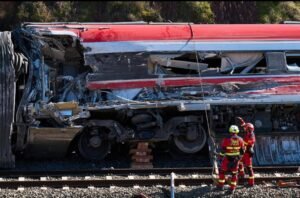
Both trains were carrying hundreds of passengers. Reports indicated that 397 people were aboard the Renfe train and 147 on the Iryo service.
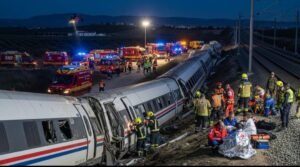
Rescue workers, firefighters, police officers, medical personnel and military emergency teams were deployed to the scene. Ambulances and medical helicopters transported injured passengers to hospitals, while survivors were helped away from the wreckage.
Witnesses described a terrifying impact that threw passengers from their seats and sent luggage and other belongings flying through the carriages. Some survivors escaped through windows, while others required assistance to get out of the damaged trains.
Spain’s Transport Minister, Óscar Puente, said preliminary information pointed to a failure involving the railway’s safety system and an instruction for the Renfe train to resume movement. He said the train should not have been authorised to proceed while a stop signal remained active.
The minister stressed that investigators were still examining the sequence of events. The precise circumstances, including the operation of the signalling system and the train’s movements before impact, remain subject to investigation.

Prime Minister Pedro Sánchez visited the crash site and announced that the government would declare three days of national mourning. He described the incident as a national tragedy and called for measures to strengthen railway safety and restore public confidence.
The collision has renewed concerns about the safety of Spain’s extensive high-speed rail network, which has been a source of national pride and a major part of the country’s transport infrastructure.
The latest disaster follows a deadly train collision in January 2026 near Adamuz in Córdoba province, which killed 46 people. That accident involved trains operated by the same companies and raised questions about railway maintenance and infrastructure safety.
Spain has invested heavily in high-speed rail over several decades, developing one of the world’s largest networks. However, the latest collision is expected to intensify scrutiny of railway safety systems, maintenance spending and the management of train traffic.
Authorities are continuing to investigate the Toledo crash, while emergency teams work to identify victims, assist affected families and complete recovery operations.