
General News
HURIWA Demands Petrol Price Cut, Says CNG Buses Cannot Fix Nigeria’s Cost-of-Living Crisis

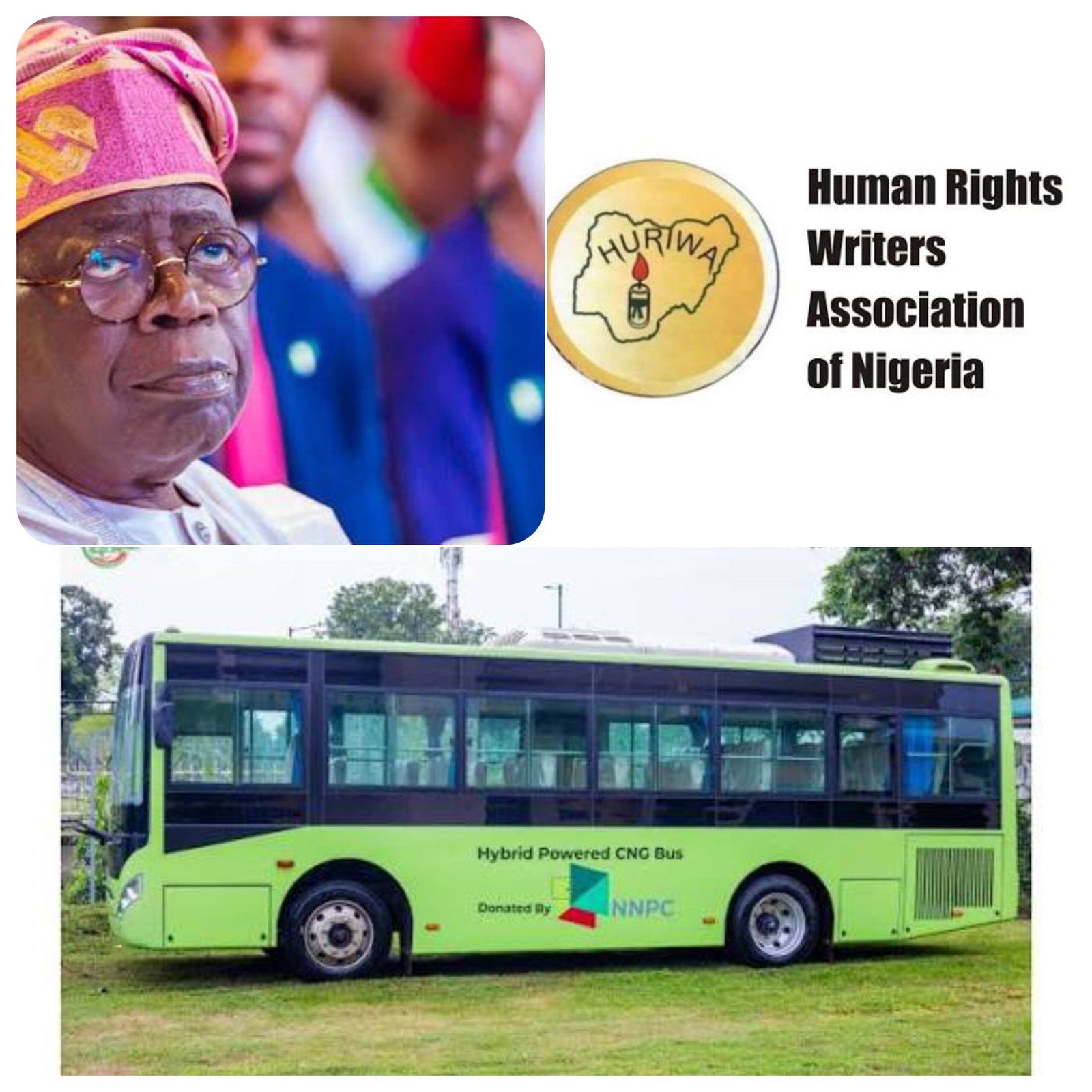
The Human Rights Writers Association of Nigeria (HURIWA) has urged President Bola Tinubu to urgently reduce the cost of petrol, arguing that Compressed Natural Gas (CNG) buses alone cannot address Nigeria’s worsening cost-of-living crisis.
The group made the demand in a statement on Sunday, following the President’s directive to the 36 state governors to ensure measurable reductions in transportation costs from October 1 through expanded CNG and electric-powered public transportation programmes.
HURIWA acknowledged that cheaper-energy buses could provide relief for commuters but said the initiative should not be presented as a comprehensive solution to the broader economic challenges facing Nigerians.
The association called for a drastic reduction in petrol prices towards the N180 per litre level recorded in 2021, arguing that high energy costs have continued to drive up the prices of transportation, food, manufacturing, agriculture, logistics, construction and other economic activities.
According to HURIWA, the impact of expensive petrol extends far beyond the filling station, as businesses and households incur higher costs for transportation, electricity generation, movement of raw materials and distribution of goods.
It said manufacturers face increased production and logistics costs, farmers spend more moving produce, traders pay more to transport goods to markets, while small businesses relying on generators also bear higher operating expenses.
HURIWA consequently faulted what it described as an approach that places much of the responsibility for reducing transportation costs on state governors.
The group said governors could provide transport interventions but lacked the capacity to independently determine crude oil prices, regulate the entire downstream petroleum sector or resolve the structural problems affecting the country’s energy market.
“Governors cannot determine the international price of crude oil, regulate the entire downstream petroleum sector or independently resolve the structural weaknesses responsible for Nigeria’s energy crisis,” the association said.
HURIWA urged Tinubu to move beyond temporary palliatives and deploy fiscal, regulatory and market-based measures capable of stabilising energy costs while protecting vulnerable Nigerians.
It also called for greater transparency in the pricing of petrol, including the costs associated with crude oil, refining, importation, transportation, margins, taxes and other charges.
The association said Nigerians should be provided with clearer information on the factors responsible for the current pump price and the measures being taken by the government to reduce the burden.
While welcoming the expansion of CNG conversion centres and alternative-energy transportation, HURIWA cautioned that CNG buses could only address part of the problem.
“A CNG bus can reduce the fare paid by a passenger on one route; it cannot by itself reduce the cost of feeding a family, operating a factory, transporting farm produce or powering thousands of small businesses,” the group said.
HURIWA expressed particular concern about the impact of persistent energy costs on manufacturers, warning that businesses could be forced to reduce production, increase prices or shut down if operating costs remain unsustainable.
It said such developments could worsen unemployment, weaken domestic production and increase dependence on imported goods.
The rights group therefore urged the Federal Government to treat energy-price stability as a national economic priority rather than principally as a transportation issue.
It called for accelerated domestic refining capacity, greater competition in the downstream petroleum sector, transparent pricing and targeted interventions to reduce energy costs for manufacturers, farmers, transport operators and households.
HURIWA also appealed to state governments to ensure that transport subsidies and other interventions genuinely benefit commuters rather than transferring the burden of expensive transportation to already struggling citizens.
The association further urged the President to convene economic managers, state governments, labour, manufacturers, transport operators and civil society organisations to develop a sustainable framework for reducing energy and transportation costs.
HURIWA said the ultimate objective should be to restore citizens’ purchasing power, revive domestic production and halt the erosion of living standards.
It maintained that CNG remained part of the solution but should not be used as a substitute for addressing the wider fuel-price crisis.
“The time for fragmented interventions is over. Nigeria needs a comprehensive economic response that puts the welfare of its citizens at the centre,” HURIWA said.