
General News
State Police Near Reality as Akpabio Mobilises Senators for Historic Constitutional Vote

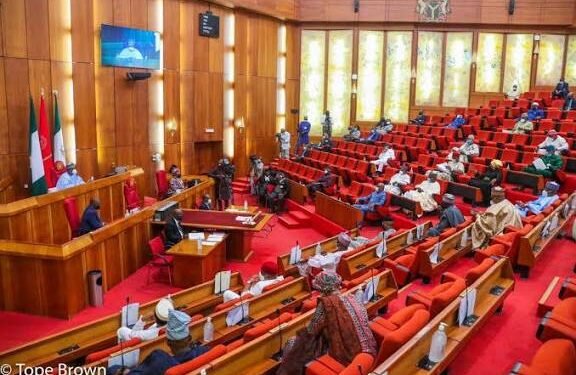
President of the Senate, Senator Godswill Akpabio, has rallied lawmakers to ensure full attendance at Wednesday’s plenary session as the National Assembly prepares to vote on a constitutional amendment bill seeking to establish state police services across Nigeria.
The proposed legislation, widely regarded as one of the most significant security reforms since Nigeria’s return to democratic rule, is expected to reshape the country’s policing structure by decentralising law enforcement and granting states greater responsibility for internal security.
Addressing senators during an emergency plenary on Tuesday, Akpabio described the State Police Bill as a landmark reform that could fundamentally transform Nigeria’s security architecture and strengthen grassroots security management.
He urged lawmakers to treat the vote as a national duty, stressing that constitutional amendments require broad participation and cannot succeed without the active involvement of members of the Senate.
“Since 1960, Nigeria has not had the courage to decentralise policing, and this is the first time,” Akpabio said.
“As we struggle to become senators, let us also remember the responsibilities of being a senator. It is not enough for us to seek tickets and, after getting them, fail to come to the chamber.”
The Senate President noted that the proposed amendment to the 1999 Constitution would provide the legal foundation for state police services while incorporating safeguards against abuse through subsequent legislation, regulatory oversight, and accountability mechanisms.
According to him, the reform would deepen community policing by integrating local governments, traditional rulers, community leaders, youth groups, and other grassroots stakeholders into the nation’s security framework.
He argued that residents of local communities are often better positioned to identify criminal elements and suspicious activities within their environments, making decentralised policing a more effective tool for intelligence gathering and crime prevention.
“Security challenges today require local solutions. Communities know their terrain, understand their peculiar challenges, and can provide actionable intelligence that may not be readily available through a centralised policing structure,” he said.
Two-Thirds Majority Crucial
Also speaking, Senate Leader Senator Opeyemi Bamidele underscored the importance of attendance, reminding lawmakers that constitutional amendments require the support of at least two-thirds of senators.
“We need a minimum of two-thirds of distinguished senators to be able to vote on constitutional alteration. That means it is important for all of us to be here,” Bamidele stated.
He described the state police proposal as a national issue that transcends political affiliations, regional interests, and ethnic considerations.
Bamidele therefore called on principal officers and members of the Senate to reach out to absent colleagues and ensure their presence for what he described as a critical legislative exercise.
Following deliberations, the Senate adjourned plenary until Wednesday, June 24, 2026, when lawmakers are expected to debate and vote on the constitutional amendment bill.
Longstanding Debate Gains Momentum
The push for state police has gained renewed momentum amid worsening insecurity across several parts of the country, including insurgency in the North-East, banditry in the North-West, kidnapping across major highways, and communal violence in various regions.
For years, governors, security experts, traditional rulers and civil society organisations have advocated the decentralisation of policing, arguing that Nigeria’s centrally controlled police system is overstretched and unable to adequately respond to local security challenges.
Supporters of the proposal maintain that state-controlled police forces would improve intelligence gathering, response times and coordination with local communities.
However, critics have continued to express concerns that state police could be abused by governors and political actors to intimidate opponents, influence elections, or suppress dissent.
To address such concerns, lawmakers have indicated that robust legal safeguards and oversight mechanisms would accompany any constitutional amendment establishing state police.
The proposed reform received a major boost after President Bola Ahmed Tinubu publicly endorsed the initiative as part of broader efforts to tackle the country’s persistent security challenges.
If approved by the National Assembly and ratified by the required number of state Houses of Assembly, the amendment would mark a historic shift in Nigeria’s security governance and potentially usher in the most significant policing reform since independence.