
General News
Tinubu Courts Global Investment, Says Nigerian Youths Ready to Power Digital Economy

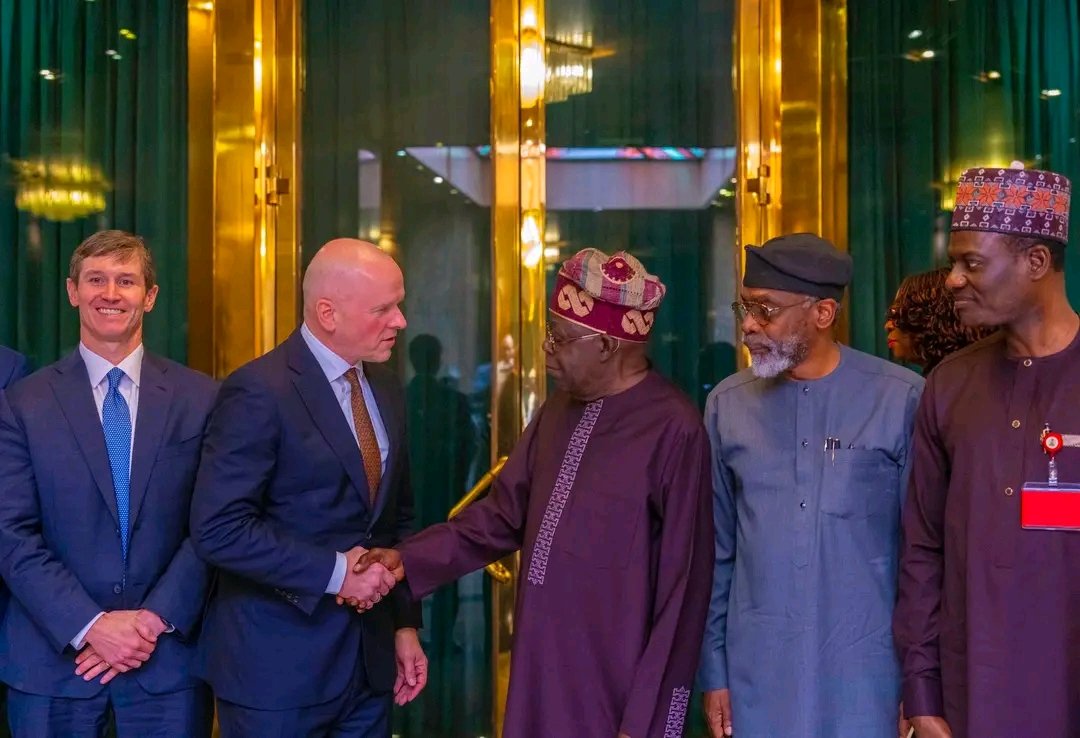
President Bola Ahmed Tinubu has assured global investors that Nigeria’s youthful population possesses the skills, adaptability and technological capacity required to thrive in the global digital economy, describing the country’s young people as its greatest asset.

The President gave the assurance on Tuesday while receiving a delegation from Mastercard led by its Global Chief Executive Officer, Michael Miebach, at the Presidential Villa, Abuja.
Tinubu also welcomed Mastercard’s proposal to train five million Nigerian businesses in digital skills, describing the initiative as a major boost to the administration’s efforts to drive economic inclusion, innovation and enterprise development.
According to the President, ongoing economic reforms have repositioned and stabilised Nigeria’s economy, creating opportunities for greater participation in global markets while empowering young people and small businesses with the tools needed for future growth.
“Our most important asset is our youth,” Tinubu said.
“What you have been doing with our young population is commendable, and we will continue to support that in every form. As the host country, the agreements we have with you are valid, and I want you to see us as partners.”
The President noted that Nigeria’s largely informal business sector is undergoing rapid formalisation, creating fresh opportunities for digital transactions, investments, employment and economic expansion.
He observed that more small businesses are registering with government agencies and increasingly embracing technology-driven solutions to improve productivity and market access.
Tinubu also urged Mastercard to deepen engagement with the Bank of Industry (BOI), noting that the institution maintains an extensive database of Micro, Small and Medium Enterprises (MSMEs) that could benefit from digital payment platforms and financial inclusion programmes.
“Payment plans and platforms are very necessary for the inclusion of small and medium-scale businesses,” he said.
Reforms Driving Formalisation, Digital Growth
Speaking during the meeting, Chairman of the Presidential Committee on Fiscal Policy and Tax Reforms and Minister of Finance and Coordinating Minister of the Economy-designate, Taiwo Oyedele, said President Tinubu’s economic reforms have opened significant opportunities in digital finance, credit systems and business formalisation.
According to Oyedele, more than 10,000 informal businesses have applied for registration daily in recent months as a result of ongoing tax and fiscal reforms.
“We are creating opportunities for work within the digital economy and formalising the very large informal sector that we have in Nigeria,” he said.
“One of the major reforms by Mr President in fiscal and tax matters has led to more than 10,000 informal businesses applying for registration every day over the past few months.”
He explained that the administration’s reforms extend beyond taxation to include consumer credit, mortgages, auto financing, student loans and small-business lending, all aimed at expanding economic participation.
Oyedele further highlighted opportunities for Mastercard to support seamless payment systems across Africa, including initiatives that could facilitate transactions using local currencies such as the naira without dependence on third-party currencies.
He also noted that five of Africa’s nine fintech unicorns are based in Nigeria, underscoring the country’s growing reputation as a leading technology hub.
Mastercard Pledges Support for Economic Reforms
In his remarks, Mastercard’s Global CEO, Michael Miebach, reaffirmed the company’s commitment to supporting Nigeria’s economic transformation agenda and expanding digital opportunities for businesses and consumers.
Miebach, who revealed that he personally established Mastercard’s operations in Nigeria in 2011, described the country as one of the company’s most strategic markets.
“It is a little bit like coming home,” he said.
“We have a business here since 2011, and we have seen the country grow and lead. We have seen your clear alignment of fiscal and monetary policy, and there is a lot of momentum in Nigeria.”
The Mastercard chief disclosed that the company currently helps prevent approximately $200 million in fraud annually in Nigeria while facilitating about $2 billion in foreign exchange inflows.
He said the company is also working with Nigerian banks and financial institutions to unlock the potential of the country’s estimated 40 million small and medium-sized enterprises.
“We want to connect the diaspora to the homeland and ensure Nigeria becomes the most thriving and biggest economy on the continent,” Miebach said.
He added that Mastercard has already developed frameworks and platforms designed to equip millions of small businesses with digital skills, cybersecurity awareness and tools required to compete effectively in an increasingly digital marketplace.
“Many small businesses want a digital component to their business, but they do not know how to do it. Capacity building is critical, not only to help them operate online but also to keep them safe in a cyber world,” he said.
Five Million Businesses to Benefit
Miebach disclosed that Mastercard has designed a three-year programme aimed at supporting small businesses through training, technical workshops and practical digital solutions.
He said the initiative would focus on inclusivity, trust, resilience and participation in the digital economy while strengthening cybersecurity capabilities.
The programme will also leverage Mastercard’s Cyber Centre of Excellence, which provides threat intelligence, incident response support and insights into emerging risks associated with artificial intelligence and digital technologies.
The proposed partnership aligns with the Federal Government’s broader agenda to deepen financial inclusion, strengthen digital infrastructure and create sustainable opportunities for millions of young Nigerians and small businesses.
Analysts say the collaboration could significantly boost Nigeria’s digital economy ambitions while expanding access to modern financial services for entrepreneurs across the country.