
International
US Pressures Allies to Distance Themselves From Anti-Disinformation Conference

The United States has lobbied Canada and European allies to withdraw or reduce their involvement in an international conference on disinformation after objecting to a panel examining whether Washington itself poses a foreign information manipulation and interference threat to Europe, according to US officials and correspondence reviewed by Reuters.
The conference, known as #Disinfo2026, is being held on October 7 and 8 in Vilnius, Lithuania, and is organised by Brussels-based nonprofit EU DisinfoLab. The organisation describes the gathering as an annual meeting of researchers, journalists, policymakers and other experts working on disinformation and information manipulation.

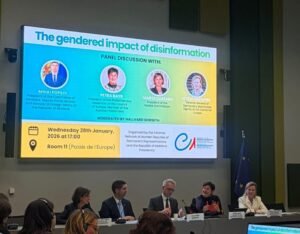
The dispute centres on a panel titled “USA as a FIMI threat: acknowledge, adapt, push back.” FIMI refers to foreign information manipulation and interference, a term commonly used in European discussions about coordinated efforts to influence information environments.
According to Reuters, the panel was intended to examine what it described as one of the difficult questions facing the counter-disinformation field: how the United States came to be viewed as a potential FIMI threat in Europe.
US State Department officials reportedly contacted counterparts in Lithuania, Canada and France over the conference. Three US officials familiar with the matter told Reuters that American diplomats persuaded the Canadian and Lithuanian foreign ministries to distance themselves from the event.
US Ambassador to Lithuania Kara McDonald was also involved in the outreach to Vilnius, according to two US officials cited by Reuters.
The changes became visible on the conference’s website, where Lithuania’s foreign ministry and Global Affairs Canada had previously been listed among the main supporters. The European External Action Service, the EU’s diplomatic arm, also disappeared from the list, although Reuters said it could not establish whether the US State Department had directly contacted the EU service.

France remained the only main government supporter listed for the conference.
The US State Department did not publicly detail the diplomatic conversations but defended its position.
A department spokesperson said that countries distancing themselves from the event should not be surprising after the United States was labelled a disinformation threat, arguing that such language undermined shared objectives in combating information manipulation.

Canadian officials gave a different explanation for their decision.
Global Affairs Canada said its officials were still participating in the conference but had revised their involvement in some sessions because of what it described as changes in the framing of several panel discussions.
Lithuania’s foreign ministry similarly said it had cancelled its participation because parts of the programme differed from the government’s official position.
EU officials also said the organisation’s decision to withdraw its support was linked to the framing of some discussions, which they said did not correspond with official EU positions on the United States’ role in disinformation.
However, reporting by The Guardian said the EU continues to provide funding for the conference despite removing its official branding as a supporter. France, meanwhile, maintained its backing, with a French diplomatic source saying the conference remained useful for developing European policy on disinformation.
The controversy has highlighted a broader debate over how governments should respond when discussions about foreign information manipulation turn toward their own actions.
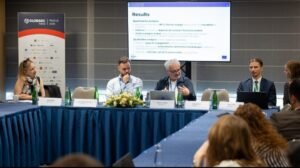
EU DisinfoLab’s programme describes the 2026 conference as covering several areas, including information spaces, enforcement, investigations, solutions and artificial intelligence. Its published programme also specifically identifies the United States as a subject of discussion in relation to FIMI.
The conference opened in Vilnius with an interview with International Criminal Court Judge Kimberly Prost, who was placed under US sanctions after she and other ICC judges authorised an investigation into alleged war crimes involving the US military in Afghanistan.
The dispute over the conference comes amid increasing disagreement between Washington and some European governments and civil society groups over issues involving free expression, online regulation and the definition of foreign interference.
For the organisers, however, the conference remains focused on examining the changing information environment and developing responses to manipulation campaigns, including those involving governments, political actors and emerging artificial intelligence technologies.
The episode has now placed the United States itself at the centre of a conference designed to examine how information manipulation affects democratic societies.