
Health
Nobel Medicine Prize Goes to Three Scientists for Breakthrough Research Into Brain Activity

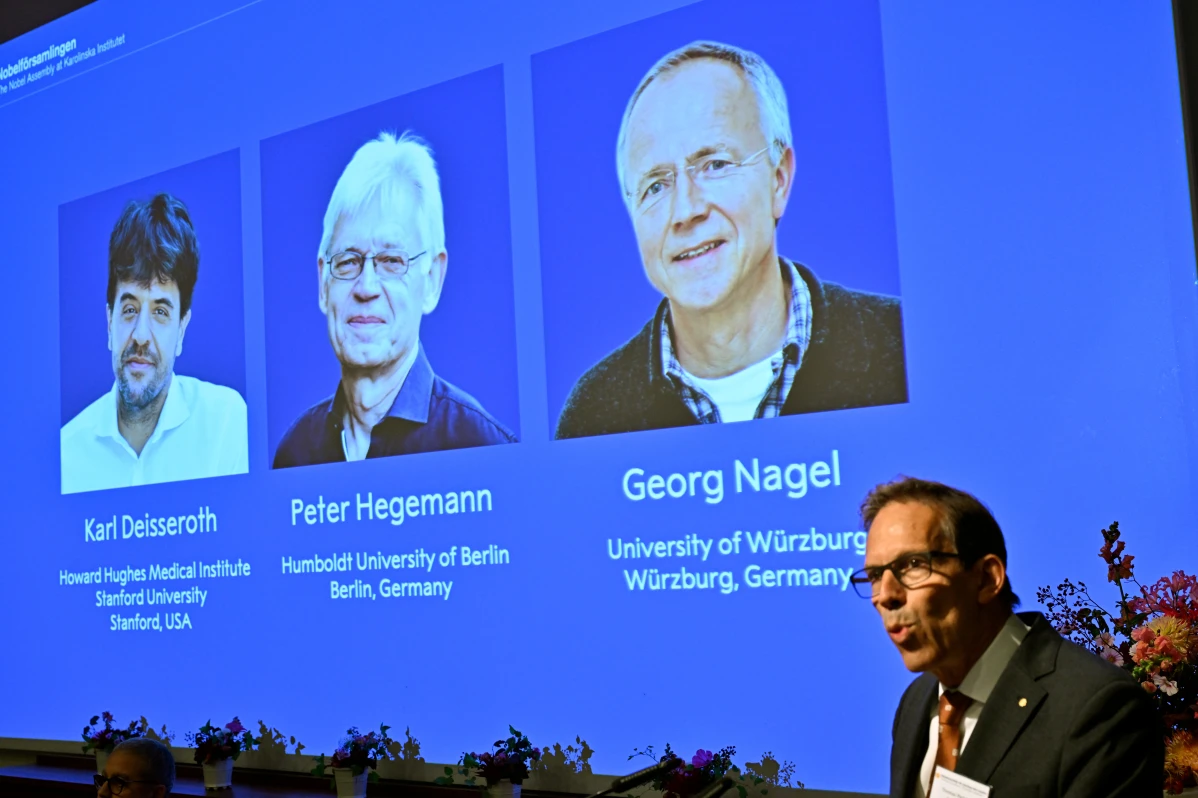
The 2026 Nobel Prize in Physiology or Medicine has been awarded to three scientists whose research has transformed the way researchers study the brain and control the activity of individual nerve cells.
American scientist Karl Deisseroth and German scientists Peter Hegemann and Georg Nagel were announced as the joint winners on Monday, October 5, for their discoveries concerning light-gated ion channels and optogenetics.
The Nobel Assembly at Karolinska Institutet said the scientists’ work had opened a new era in neuroscience by making it possible to switch individual nerve cells on or off using light. The technique has given researchers a much more precise way of investigating how the brain controls memory, emotions, behaviour and other functions.
Hegemann and Nagel’s research began with the study of a single-celled alga called Chlamydomonas, which responds to light. The scientists discovered a light-sensitive protein known as channelrhodopsin. When exposed to blue light, the protein opens a channel that allows charged particles to pass through the cell membrane, generating an electrical signal.
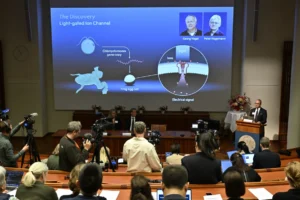
Deisseroth later built on that discovery by introducing the gene responsible for channelrhodopsin into nerve cells. In experiments, blue light could then be used to trigger electrical activity in the neurons. His team subsequently demonstrated that the technique could control nerve cells in the brains of living mice.
The resulting technique, known as optogenetics, allows scientists to target specific populations of neurons and manipulate their activity with light. This has helped researchers investigate the connections between particular brain circuits and functions such as memory, feelings and behaviour.

The Nobel Committee described optogenetics as a method now used in laboratories around the world to investigate the brain. The technique has also opened avenues for research into neurological and psychiatric conditions by helping scientists identify the specific neural circuits involved in disease.
Deisseroth, 54, is based at Stanford University in the United States, while Hegemann, 71, is a professor at Humboldt University of Berlin and Nagel, 73, is based at the University of Würzburg in Germany.

The three laureates will share a prize of 12 million Swedish kronor, approximately $1.2 million. The medicine award traditionally opens Nobel Prize week, with prizes in physics, chemistry, literature and peace to follow, while the economics prize will be announced later in the month.
The 2026 award recognises research that has fundamentally changed scientists’ ability to investigate the living brain, allowing them to move beyond simply observing neural activity to experimentally testing how specific nerve cells and circuits influence behaviour.