
General News
Atiku Rules Out Fuel Subsidy Comeback, Pledges Targeted Support to Cut Costs

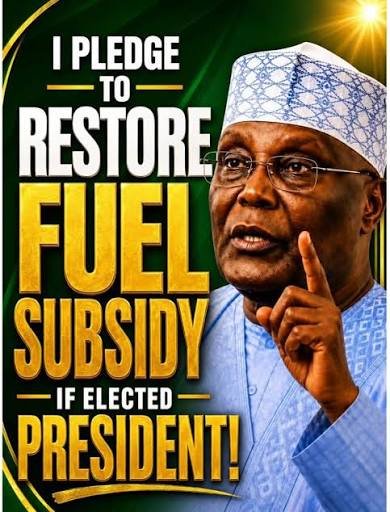
Former Vice President and African Democratic Congress (ADC) presidential candidate, Atiku Abubakar, has rejected suggestions that his administration would restore Nigeria’s former fuel import subsidy regime, saying any petroleum intervention under his leadership would be targeted, temporary and tied to measurable performance.
Atiku’s position followed comments attributed to one of his aides suggesting that an Atiku administration would restore fuel subsidy and later remove it.
In a statement, Atiku’s Senior Special Assistant on Public Communication, Phrank Shaibu, described the comments as an “unauthorised, imprecise and materially misleading characterisation” of the former vice president’s policy.
Shaibu stressed that Atiku had never proposed returning to the old subsidy system, which he said should not be attributed to the ADC candidate.
“For the avoidance of doubt, Atiku has never proposed restoring the old import-subsidy regime and subsequently removing it on a predetermined date. That is not his policy and should not be attributed to him,” he said.
According to him, Atiku’s proposed petroleum intervention would instead focus on supporting domestic refining and production in order to reduce costs, increase supply and strengthen competition.
He said the intervention would be capped, transparently budgeted and independently audited, with performance-based conditions determining when government support would be scaled down.
“What Atiku proposes is a targeted, capped, transparently budgeted and independently audited intervention to support domestic refining and production, with measurable performance-based exit conditions built in from day one,” Shaibu said.
He explained that the objective was not to perpetually subsidise inefficiency but to create conditions under which government support would eventually become unnecessary.
Shaibu said the withdrawal of the intervention would therefore depend on measurable improvements rather than an arbitrary calendar date.
These, he said, would include increased domestic refining, improved supply stability, stronger competition and the development of a market capable of delivering affordable petroleum products without continued government support.
“You do not remove scaffolding because the calendar says so. You remove it when the building can stand securely on its own,” he said.
The former vice president’s spokesman also said the debate over subsidy terminology should not distract from what he described as the more pressing challenge facing Nigerians — the rising cost of living.
“The real question is simple: Why has everything become so expensive, and what will Atiku do to make life affordable again?” Shaibu asked.
He accused the President Bola Tinubu administration of transferring the impact of its economic reforms to Nigerian households, while promising that an Atiku government would focus on reducing production and transportation costs, strengthening domestic refining, increasing supply and restoring purchasing power.
“The choice is not between the removal of subsidy and the restoration of subsidy. The choice is between an Expensive Nigeria and an Affordable Nigeria,” Shaibu said.