
Disaster/Tragedy
British Columbia Declares State of Emergency as Wildfires Force More Than 20,000 to Flee

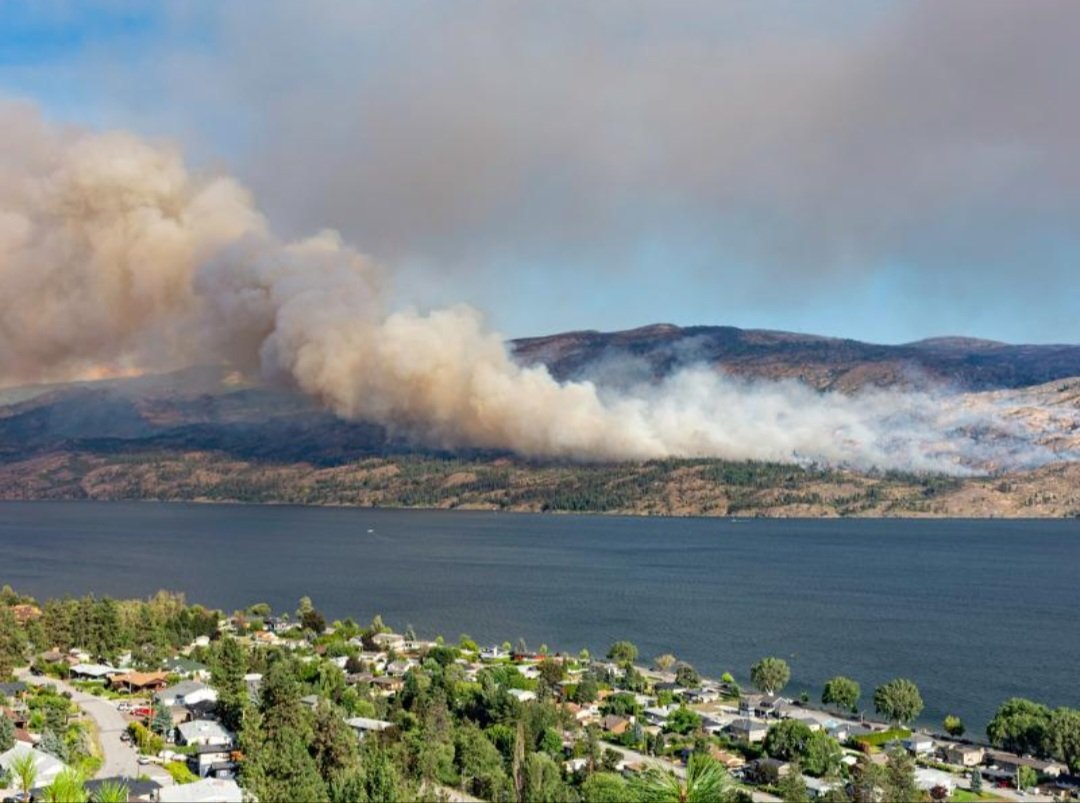
British Columbia has declared a province-wide state of emergency after fast-moving wildfires tore through parts of the Canadian province, forcing more than 20,000 people to evacuate and destroying homes and other properties.
The emergency declaration was announced Saturday by Premier David Eby as more than 100 wildfires burned across British Columbia, with nearly half classified as out of control. Hot, windy weather combined with prolonged drought has created what fire officials described as “explosive” conditions.
The most dramatic evacuation has been in the southern Interior, around Okanagan Lake, where the rapidly expanding Bald Range wildfire forced entire communities to flee.
The Bald Range wildfire was first reported on Friday evening but expanded at extraordinary speed.
According to Reuters, the blaze grew to approximately 9,500 hectares (23,500 acres), nearly doubling in size overnight. The Associated Press reported that it had spread across more than 100 square kilometres at one stage as it raced toward Okanagan Lake.
The fire overwhelmed the smaller community of Faulder before advancing toward Summerland, covering roughly 15 kilometres in a matter of hours.
British Columbia Wildfire Service operations director Cliff Chapman described the situation as “explosive”, warning that other communities could face similarly rapid-moving fires.
Premier Eby said the fire became so intense that it generated its own weather system, including lightning, which can further complicate firefighting and potentially ignite additional fires.
The entire community of Summerland, which has about 12,000 residents, was ordered to evacuate overnight.
Around 8,000 additional people in and around Peachland were also ordered to leave as the fire moved rapidly through the region. Other evacuation orders affected areas including the Peachland watershed, Brenda Mines, Lower Princeton and parts of its downtown area.
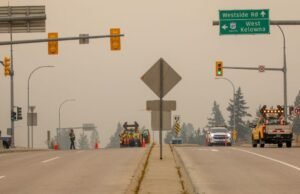
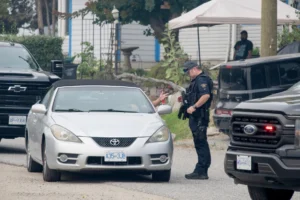
Many residents left in the middle of the night, driving toward Penticton or Kelowna before road closures made escape more difficult.
Traffic became heavily congested as thousands attempted to leave at the same time.
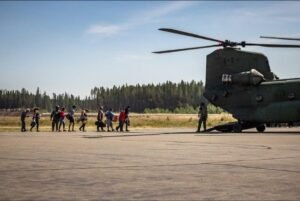
Some residents were unable to escape by road and had to be rescued by helicopter. British Columbia officials said firefighting aircraft were diverted from their normal operations to help evacuate people trapped by the advancing flames.
The Associated Press reported that 18 firefighting aircraft rescued more than 50 people.
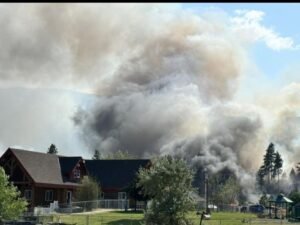
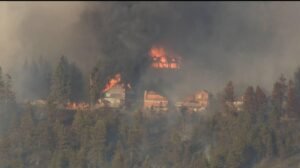
The fires have already destroyed homes, although authorities said Saturday that they were unable to provide a definitive figure because firefighters could not safely enter some affected areas.
Videos and photographs from the region showed flames and thick smoke close to homes and roads, while residents fled with whatever belongings they could gather.
British Columbia’s premier acknowledged the devastation, saying people had lost homes and that many others were displaced or waiting for information about relatives.
Officials also warned that search-and-rescue teams were checking areas behind fire lines for people who might have become trapped.
Authorities were also investigating a possible wildfire-related death near Summerland, although dangerous conditions had prevented officials from confirming the fatality.
The speed of the fire became so extreme that even emergency personnel responsible for coordinating the response had to leave.
Erick Thompson, an emergency official with the Regional District of Okanagan-Similkameen, said he abandoned the emergency operations centre to evacuate his own family.
He recorded a video from his vehicle as traffic backed up while residents attempted to escape the area.
The incident underscored the extraordinary speed with which the fire was changing conditions on the ground.
The province-wide declaration gives the British Columbia government additional emergency powers to coordinate the response.
Emergency Management Minister Kelly Greene said authorities can use the powers to impose travel restrictions and secure accommodation for evacuees, among other measures.
The declaration also provides additional tools for coordinating rescue operations and managing resources during the crisis.
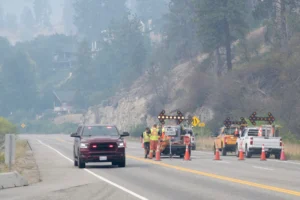
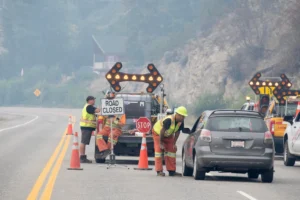
Highway 97, a major transportation route through the region, was closed between Peachland and Penticton as evacuation traffic surged.
The road closure further complicated efforts by residents to get out of threatened communities.
The crisis extends well beyond the Bald Range fire.
More than 100 wildfires were burning across British Columbia, with nearly half classified as out of control, according to officials.
Reuters reported that approximately 1,500 firefighters were battling the fires, while the province had issued dozens of evacuation orders and alerts.
Firefighters from outside Canada have also been helping with the country’s wider wildfire response. Teams from countries including Mexico, Australia, France and New Zealand have provided assistance as Canadian provinces struggle with numerous major fires.
The wildfire emergency is unfolding amid hot and dry conditions that have left vegetation highly vulnerable to burning.
British Columbia had already warned earlier this summer that prolonged drought and above-normal temperatures were increasing wildfire risks in several parts of the province, including the Okanagan and lower Thompson regions.
The latest fires demonstrate how quickly those conditions can translate into a major humanitarian emergency.
Strong winds can push flames rapidly across dry vegetation, while intense heat can make firefighting more difficult and increase the likelihood of extreme fire behaviour.
The situation in British Columbia is also part of a wider pattern across Canada, where large wildfires have affected several provinces this year.
Reuters reported that fires have burned roughly 4 million hectares (9.9 million acres) across Canada this year, according to the Canadian Interagency Forest Fire Centre.
The emergency is particularly significant for the Okanagan region, which is known for agriculture and wine production.
The region produces much of British Columbia’s wine and is Canada’s second-largest wine-producing area, meaning the fires pose risks not only to homes but also to farms, vineyards, businesses and local tourism.
Summerland Mayor Doug Holmes said numerous farms had been affected but that officials still did not know the full extent of structural losses.
“We have to brace ourselves for the worst,” he said, according to Reuters.

The fire has also affected local infrastructure. Summerland lost power and issued a boil-water notice after wildfire conditions forced water-treatment arrangements to be altered and untreated water entered the system.
Authorities have repeatedly warned residents not to delay evacuation orders.
With fires moving much faster than many conventional evacuation plans anticipate, officials say residents should leave immediately when ordered rather than waiting to see whether the flames approach their homes.
Premier Eby urged people in affected areas to continue following official instructions.
The immediate priority remains saving lives, rescuing trapped residents, protecting critical infrastructure and preventing the fires from spreading into additional communities.

But with more than 100 fires burning and weather conditions remaining dangerous, officials acknowledge that the situation could deteriorate further before it improves.
The British Columbia emergency is another reminder of the growing threat posed by extreme wildfire conditions in western Canada.
For the thousands of residents who fled Summerland, Peachland and surrounding communities, the crisis is no longer simply about a distant forest fire.
It has become a race against time to find safety, protect families and wait for news about homes and communities left behind.