
Disaster/Tragedy
Magnitude 4.7 Earthquake Strikes Near Naples, Causing Power Outages and Structural Damage


A magnitude 4.7 earthquake struck the Campi Flegrei volcanic area west of the southern Italian city of Naples, causing power outages, disrupting rail and metro services, and damaging buildings across the region. The tremor, one of the strongest recorded in the area in recent years, sent thousands of residents rushing into the streets as emergency crews assessed the extent of the damage.
According to Italy’s National Institute of Geophysics and Volcanology (INGV), the earthquake occurred at 7:46 p.m. local time on Friday with its epicentre in the Campi Flegrei caldera at a shallow depth of about 3 kilometres (2 miles). The shallow depth amplified the shaking, making it widely felt across Naples and surrounding communities.

Italian authorities reported minor structural damage to several residential buildings and public facilities, while local power outages affected parts of Naples and nearby towns.
As a safety precaution, local rail and metro services were temporarily suspended while engineers inspected tracks, tunnels and stations for possible damage. Emergency services also carried out inspections of schools, churches and other public buildings before allowing normal operations to resume.
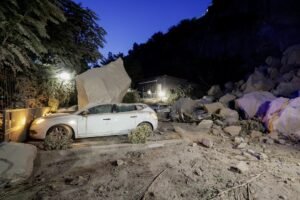
In some areas near the coast, the strong shaking triggered rockfalls, with large boulders tumbling onto parked vehicles and roads. Emergency crews worked through the night to clear debris and restore access. Initial local reports indicated a small number of people sustained minor injuries, though authorities said there were no fatalities.
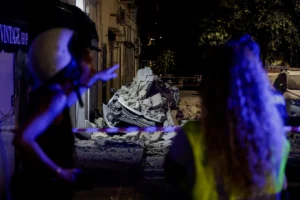
The earthquake sparked panic across the Naples metropolitan area.
Many residents evacuated homes, offices and shops immediately after the tremor, gathering in open spaces amid fears of aftershocks. Videos shared on social media showed swaying buildings, falling debris and frightened residents waiting outside while emergency officials inspected structures.
Italy’s fire service said it received numerous calls from concerned residents but reported no immediate large-scale rescue operations.
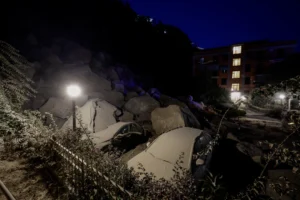
The epicentre lies within Campi Flegrei (Phlegraean Fields), a vast volcanic caldera considered one of Europe’s most closely monitored geological regions.
Scientists have observed a steady increase in seismic activity there over the past several years, accompanied by gradual ground uplift; a phenomenon known as bradyseism. While experts stress there is currently no evidence of an imminent volcanic eruption, the persistent earthquakes have heightened public concern and prompted authorities to strengthen monitoring and emergency preparedness.
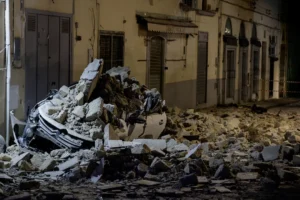
The Campi Flegrei area is home to hundreds of thousands of people, making any significant seismic event a major public safety concern. Italian civil protection authorities have updated evacuation plans and continue to conduct regular emergency drills in the region.
Prime Minister Giorgia Meloni’s government has pledged continued support for residents and has instructed civil protection agencies to closely monitor the affected area.

Geologists warned that additional aftershocks are possible in the coming days and urged residents to follow official safety guidance while inspections of damaged buildings continue. Authorities also emphasized that Italy’s earthquake monitoring network remains on heightened alert because of ongoing seismic activity in the Campi Flegrei region.

Italy is one of Europe’s most earthquake-prone countries, and the latest tremor has revived memories of previous devastating earthquakes, including the 1980 Irpinia earthquake, which killed around 2,700 people, and the 2016 Central Italy earthquake, which claimed nearly 300 lives. While Friday’s quake caused only limited damage, experts say it serves as another reminder of the geological risks faced by communities living near active fault lines and volcanic systems.