
World News
Millions Watch Rare Solar Eclipse Across UK and Europe


Millions of people across the United Kingdom and Europe turned their eyes to the sky on Wednesday as a rare solar eclipse swept across the region, creating dramatic scenes as the Moon moved between Earth and the Sun.
The August 12, 2026 eclipse was the only total solar eclipse of the year, with the path of totality crossing parts of Greenland, Iceland and northern Spain. Much of Europe, including the UK, experienced a deep partial eclipse.
The event attracted large crowds to viewing locations, particularly in Spain, where parts of the country fell directly within the path of totality. About 15 million people live within the total-eclipse path, while hundreds of millions more were able to see the Moon cover most of the Sun from locations outside the path.
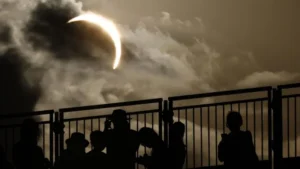
Although Britain was not within the path of totality, observers across the country witnessed an unusually deep partial eclipse.
In London, the eclipse reached about 91–92% coverage, while parts of Cornwall experienced approximately 96% coverage. Western Scotland saw around 93% coverage, according to astronomers cited by the Royal Observatory Greenwich.
The eclipse reached its maximum in London at around 7:13 p.m. local time, with the Sun already relatively low on the western horizon.
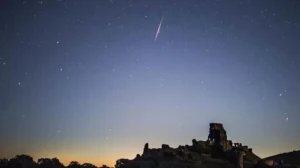
The UK event was particularly significant because the last total solar eclipse visible from parts of Britain occurred in 1999. The next total solar eclipse visible from the UK is not expected until 2090, making Wednesday’s event an exceptionally rare opportunity for British skywatchers.
Northern Spain provided some of the most spectacular views in mainland Europe, with cities including León, Valladolid, Zaragoza, Teruel and Valencia located within the path of totality.
The Moon completely covered the Sun in those areas, briefly turning daylight into twilight and revealing the Sun’s outer corona.
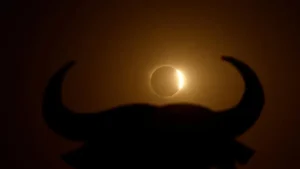
In Spain, totality occurred close to sunset, adding to the dramatic spectacle. The eclipse reached its peak in parts of the country between roughly 8:26 p.m. and 8:33 p.m. local time, depending on location.
Spain had not experienced a total solar eclipse since 1905, adding to the significance of the event for astronomers and eclipse enthusiasts.
The eclipse was visible in some form across a much wider area. Al Jazeera estimated that about 980 million people could see at least part of the Sun covered, while CBS News reported that around 230 million people could see 90% or more of the Sun obscured.
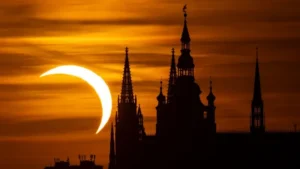
Paris experienced about 92% coverage, London around 91%, and Berlin approximately 85%.
The eclipse also reached parts of northwestern Africa and North America, although the extent of coverage varied considerably by location.
Astronomers have stressed that solar eclipses are not unusual globally, but total eclipses are rare from any particular location because the Moon’s shadow covers only a relatively narrow strip of Earth’s surface.
For those who witnessed totality, the complete blocking of the Sun lasted only around two minutes in the best locations, making the event a brief but extraordinary celestial spectacle.
The next total solar eclipse will occur on August 2, 2027, with the path crossing southern Spain, North Africa and Yemen.