
World News
Germany Set to Elect First Female President as Governing Parties Back Ilse Aigner


Germany is on course to elect its first female president after Chancellor Friedrich Merz’s conservative bloc and its Social Democrat coalition partners united behind former federal minister Ilse Aigner as their preferred candidate for the country’s highest office.
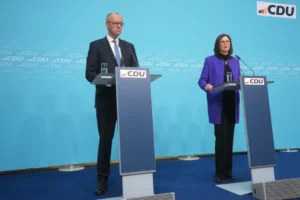
The 61-year-old Bavarian politician was formally backed by Merz’s Christian Democratic Union (CDU), its Bavarian sister party, the Christian Social Union (CSU), and the centre-left Social Democratic Party (SPD), giving her a strong chance of winning the presidential election scheduled for January 30, 2027.

The opposition Greens have also responded positively to her candidacy, further strengthening her position ahead of the vote.
If elected, Aigner will succeed President Frank-Walter Steinmeier, whose second five-year term ends in March 2027. All 12 presidents of Germany’s post-war federal republic, established in 1949, have been men.
Merz described Aigner’s nomination as an important moment for the country, saying it was time for a woman to occupy the largely ceremonial but influential position.

He praised her commitment to democratic values and her opposition to hatred and extremism, describing her as a leader capable of bringing people together.
Aigner, who currently serves as president of Bavaria’s state parliament, said she wanted to represent the political centre and help overcome divisions in German society.
She warned that democracy was facing threats from within and outside the country, pointing to the growing influence of extremist movements and the weakening of political consensus.

Aigner has had a lengthy political career spanning federal and state politics. She entered the Bavarian state legislature in 1994 before being elected to Germany’s federal parliament, the Bundestag, in 1998.
She served as federal agriculture minister under former Chancellor Angela Merkel from 2008 to 2013. After returning to Bavaria, she held senior positions in the state government, including economy and transport portfolios, before becoming speaker of the state parliament in 2018.
Germany’s president is elected by the Federal Convention, a special assembly comprising all members of the Bundestag and an equal number of delegates from the country’s 16 state parliaments. The 1,260-member body is scheduled to meet on January 30 to choose Steinmeier’s successor.
Although the president’s duties are largely ceremonial and representative, the office carries constitutional responsibilities, including signing legislation and formally appointing the chancellor and government ministers. The president is also expected to serve as a moral voice and symbol of national unity beyond everyday party politics.
Aigner’s nomination comes as Germany’s mainstream political parties face growing pressure from the far-right Alternative for Germany (AfD), whose rising popularity has intensified concerns about political polarisation.
The AfD has indicated that it intends to nominate its own presidential candidate. Its co-leader, Alice Weidel, criticised Aigner’s suitability for the role, arguing that she had not always demonstrated an ability to rise above party politics.
While Aigner is widely expected to secure the presidency because of the support behind her, the election will be conducted by secret ballot, leaving room for unexpected developments.
Her potential election would mark a historic breakthrough in German politics, placing a woman in the country’s highest constitutional office for the first time.