
World News
Robots Beat Usain Bolt’s 100m Record at Beijing Robot Games

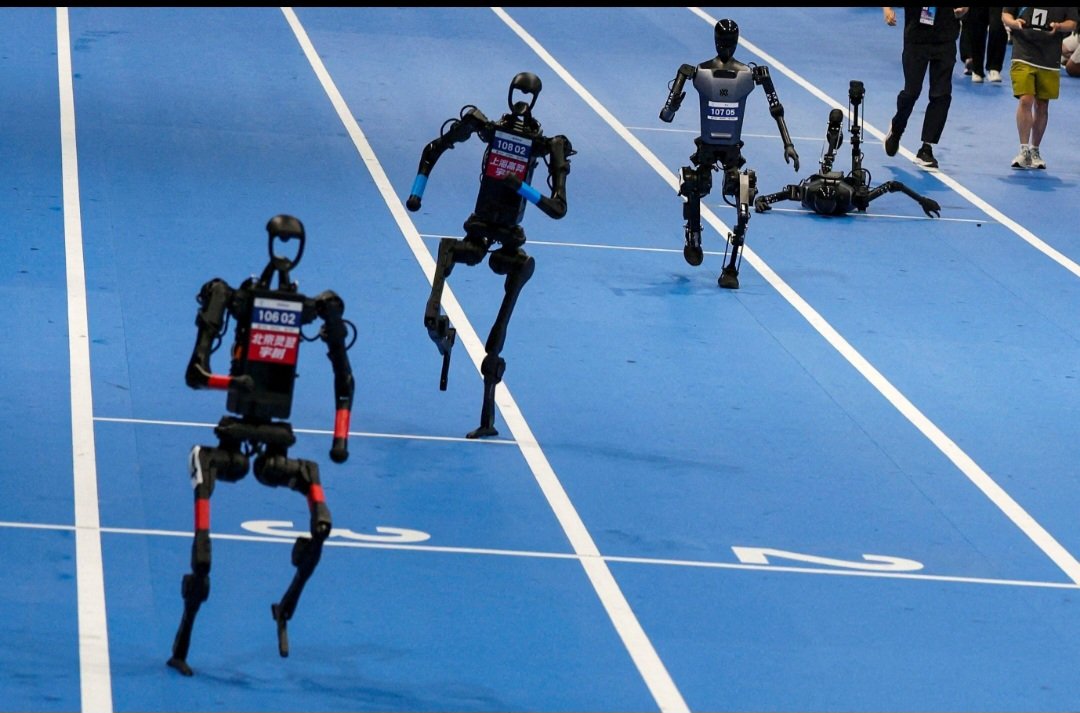
Chinese humanoid robots have stunned spectators at the World Humanoid Robot Games in Beijing after machines competing in the event broke long-standing human records in athletics.
The robots recorded extraordinary performances in the 100-metre sprint and high jump on the opening day of the five-day competition, showcasing the rapid advances being made in China’s humanoid robotics industry.
One of the most striking performances came in the 100m, where a humanoid robot developed by X-Humanoid reportedly clocked 9.39 seconds in a preliminary heat.
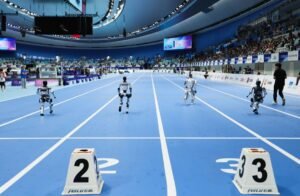
That time was faster than the 9.58-second world record set by Usain Bolt in 2009. Another Chinese robot, developed by smartphone manufacturer Honor and named Lightning, reportedly ran the distance in 9.32 seconds during a test run, although that performance was not the winning time in the final.
The machines’ performances mark a dramatic improvement in humanoid robotics, although the robots’ times are not directly comparable with official human athletics records because they were achieved under different competition conditions and rules.
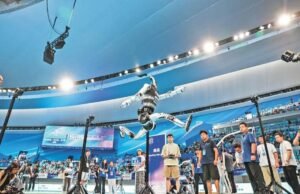
The high-jump competition produced another remarkable result. A humanoid robot cleared 2.88 metres in a standing high jump, exceeding the human men’s high-jump world record of 2.45 metres, set by Cuba’s Javier Sotomayor in 1993.
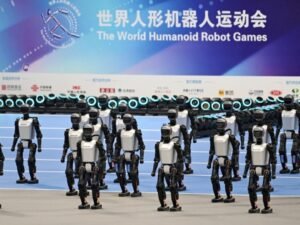
The results came as more than 2,000 humanoid robots from 666 teams gathered in Beijing for the second edition of the World Humanoid Robot Games.
The competition features 51 events, ranging from traditional sports such as running, football and table tennis to tasks designed to test robots in practical environments. More than 40% of the contests require robots to operate autonomously rather than being controlled remotely.
The event is being staged at Beijing’s National Speed Skating Oval, popularly known as the Ice Ribbon, and is part of a broader Chinese effort to demonstrate advances in artificial intelligence, robotics and advanced manufacturing.
China has made humanoid robotics a strategic technology priority, with substantial government support and growing investment from technology companies. Reuters reported that China’s robot competitions have evolved from relatively small academic contests into major showcases for the country’s robotics industry.
But the impressive athletic performances also come with a reminder of the technology’s limitations.
Some robots have struggled with basic problems such as maintaining balance, stopping after a sprint and dealing with unexpected situations. Reuters noted that the more important challenge for the industry is whether robots can translate their impressive demonstrations into useful real-world applications, such as factory work, logistics, healthcare and household tasks.
The Beijing games therefore represent more than an unusual sporting spectacle. They are being used as a testing ground for machines designed to operate in environments built for humans.
With robots now demonstrating speeds and jumping abilities beyond established human records, the competition is offering a striking glimpse of how quickly humanoid technology is developing, even as engineers continue working to make the machines reliable outside the controlled conditions of a sporting arena.