
World News
China Completes First Stage of Land Reclamation at Disputed South China Sea Reef

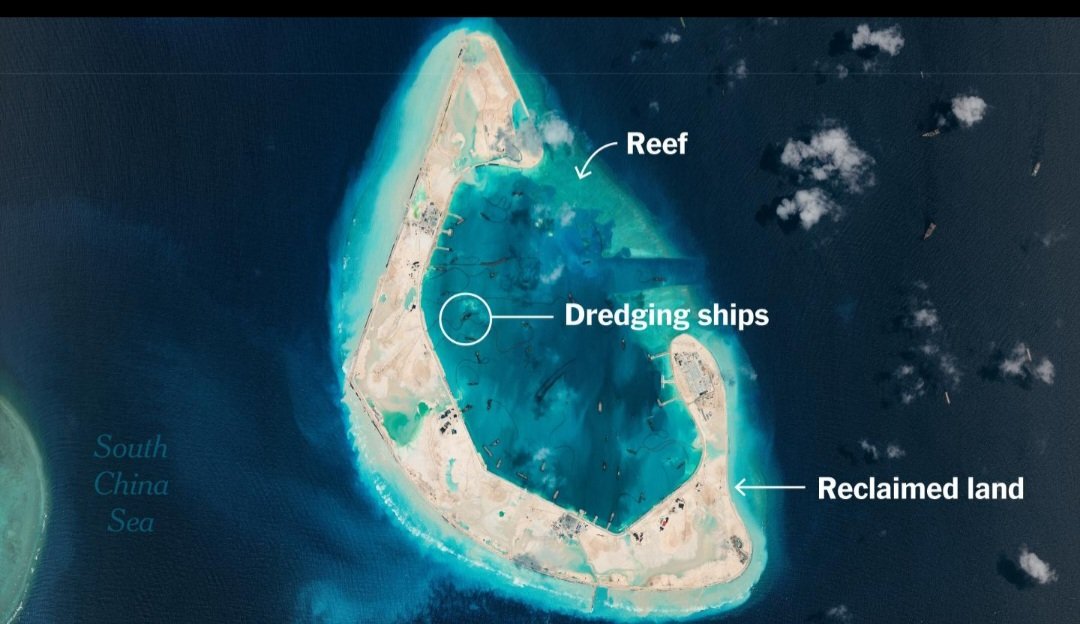
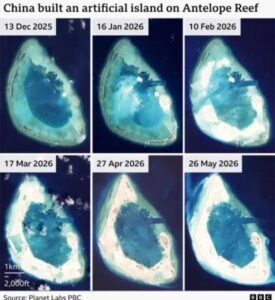
China has completed what analysts describe as the first stage of a major land-reclamation project at Antelope Reef in the disputed South China Sea, according to recent satellite imagery and regional reports.
The development at Antelope Reef, part of the disputed Paracel Islands, marks a significant expansion of China’s physical presence in an area contested by several countries, particularly Vietnam.
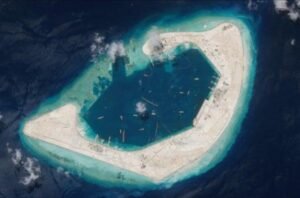
Satellite images reviewed by maritime analysts indicate that China has rapidly transformed the previously mostly submerged reef into a much larger artificial landmass. The project is understood to be the first major Chinese island-building effort in the South China Sea since Beijing’s large-scale reclamation campaign of the 2010s.
Antelope Reef, known as Lingyang Jiao in China and Đá Hải Sâm in Vietnam, is claimed by both Beijing and Hanoi. China has controlled the wider Paracel Islands since 1974, although Vietnam continues to reject Beijing’s sovereignty claim.
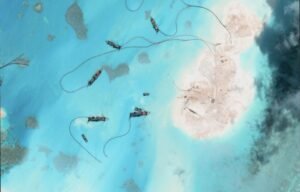
The latest construction has involved dredging and landfill operations, with numerous vessels reported around the reef. Earlier satellite observations showed more than 30 vessels believed to include dredgers and construction-support ships operating in the area.
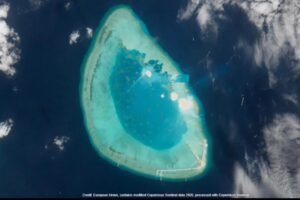
The scale of the reclamation has attracted considerable attention because it represents a return to large-scale Chinese island-building after a lengthy pause. Analysts say the newly created land could eventually accommodate infrastructure that would strengthen China’s ability to operate in the northern part of the South China Sea.
The Lowy Institute said in an April analysis that China’s work at Antelope Reef was reshaping the strategic environment in the South China Sea, while noting that construction of an outpost would not itself create new legal rights over the surrounding waters.
Vietnam has strongly objected to China’s reclamation activities in the Paracel Islands. Hanoi has said foreign activities in areas it considers Vietnamese waters without its permission are illegal and invalid.
The development comes against a backdrop of increasingly intense competition in the South China Sea. China, Vietnam, the Philippines, Taiwan, Malaysia and Brunei have overlapping territorial or maritime claims in different parts of the strategically important waterway.
The region is also a major global shipping route and is believed to contain significant fishing, oil and gas resources, making control of its waters strategically and economically important.
China has previously defended its activities in the South China Sea as legitimate construction within territory it claims as sovereign. Critics, however, argue that the construction of artificial islands and infrastructure strengthens Beijing’s ability to exercise control over contested waters.
The completion of the first stage at Antelope Reef is therefore likely to increase scrutiny from neighbouring countries and regional security analysts as attention turns to what infrastructure China may build on the newly reclaimed land.
For now, the project adds another significant development to a maritime dispute that has become one of the most closely watched security flashpoints in the Indo-Pacific.