
Opinion
Why Are We Still Policing the 21st-Century Threat with Checkpoints?

By Nick Agule
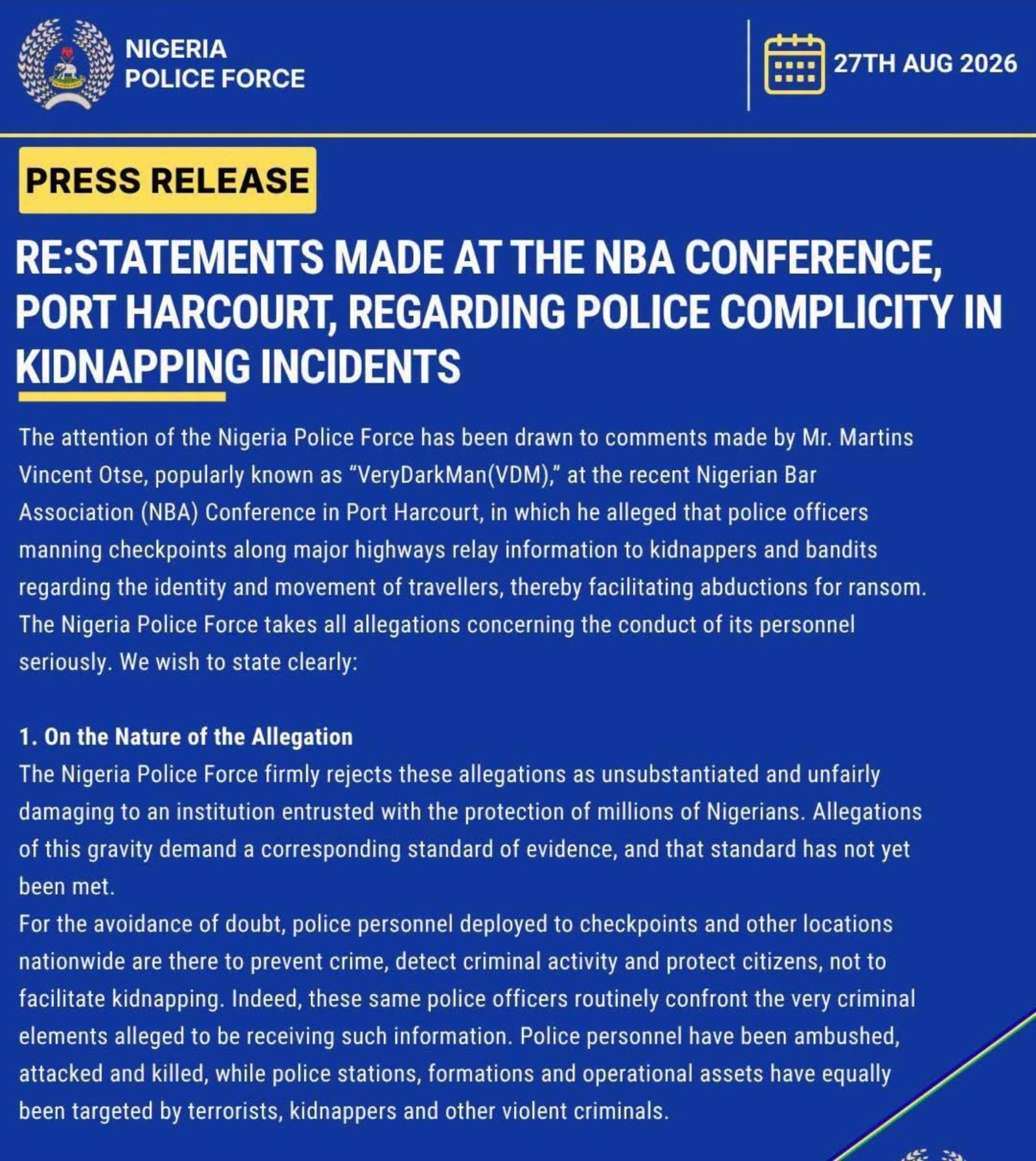
Right of Reply to the Nigerian Police Force
Why do we still need conventional security checkpoints as a major component of policing in the 21st century?
Checkpoints had a purpose when the principal threat was armed robbery, vehicle-based crime and the movement of identifiable criminals along major highways. But the threat has fundamentally changed. Today, Nigeria is dealing increasingly with bandits, kidnappers and terrorists operating in dispersed, highly mobile groups, often using motorcycles and exploiting forests and ungoverned spaces. The EU Agency for Asylum notes that the mobility and unpredictability of motorcycle-riding bandit groups have made them capable of reaching communities with little warning.
So the fundamental question is: what exactly are three, four or five police officers sitting at a checkpoint expected to do when dozens or hundreds of armed men can approach from multiple directions on motorcycles?
A checkpoint may create an appearance of police presence, but it is not necessarily an effective response to a highly mobile asymmetric threat. Worse, it can turn police officers themselves into static, predictable and exposed targets. If criminals know where officers are stationed every day, they know exactly where to strike.
We should be asking whether we are deploying our personnel according to the nature of the threat or simply continuing a policing model inherited from a different era.
Modern policing is intelligence-led, not checkpoint-led
The answer is not to abandon physical policing. It is to make it mobile, intelligence-led, technology-enabled and incident-driven.
Modern policing increasingly relies on:
– biometric and fingerprint databases;
– integrated criminal and incident databases;
– CCTV and command-and-control centres;
– Automatic Number Plate Recognition (ANPR);
– telecommunications and location intelligence;
– drones and aerial surveillance;
– digital crime mapping and predictive analytics;
– rapid-response tactical units; and
– a reliable emergency call-and-dispatch system.
Indeed, Nigeria’s own Police Affairs Ministry acknowledges that CCTV, drones and command centres are critical missing links in Nigerian policing. It reported in 2025 that only a handful of states had functional command-and-control centres and that surveillance coverage remained inadequate.
Where is the national emergency response system?
A modern security architecture should make the citizen the eyes and ears of the security system.
When a citizen sees armed men moving towards a community, witnesses a kidnapping, detects suspicious activity or is confronted by an active security incident, there should be one universally recognised emergency number.
The citizen calls.
The command centre receives the location and intelligence.
The incident is assessed.
The nearest appropriate tactical unit is dispatched.
Other relevant agencies are alerted.
CCTV, ANPR, drones, telecommunications and databases are brought into the response.
That is how a modern emergency-response architecture should work.
Nigeria has already taken a step in this direction. In April 2026, the National Economic Council approved 112 as the national emergency number, specifically to create a unified and coordinated emergency-response system.
But it is much more than simply designating 112 as the national emergency number. It must be backed up with command and control centres and effective emergency response tactical teams with overwhelming force against any threat levels identified.
Protect the police as well
There is another dimension that deserves urgent attention: force protection.
Why should police officers be permanently exposed at isolated checkpoints when they could be housed in properly protected operational bases or “super camps”, equipped with communications, surveillance, armoured mobility and rapid-response capability?
Instead of putting 5 officers in a predictable location and waiting for criminals to come to them, put 50 or 100 properly equipped personnel in a secure operational base and deploy them when intelligence indicates where the threat is.
The model becomes:
Intelligence → Command Centre → Verification → Rapid Deployment → Intervention → Arrest/Neutralisation → Investigation.
That is fundamentally different from:
Checkpoint → Wait → Hope.
And it is potentially much safer for the police.
If terrorists or bandits attack a checkpoint, those officers have limited options. If they attack a secure operational base, the security architecture can be designed to withstand the attack while simultaneously deploying a larger tactical force to the incident.
We must change the policing doctrine
Nigeria cannot defeat a 21st-century security threat with a 20th-century policing architecture.
The country should progressively move from static checkpoints to intelligence-led mobility.
That does not mean abolishing every checkpoint overnight. Checkpoints still have legitimate uses for specific intelligence-led operations and targeted searches. But they should not be the permanent principal answer to 21st century security threats that includes highly mobile terrorist and bandit groups.
The priority should be to build:
1. A genuinely functional national 112 emergency system.
2. State and regional command-and-control centres.
3. A unified national criminal and biometric database.
4. Nationwide CCTV coverage at strategic locations.
5. ANPR on major highways and strategic routes.
6. Drone-based surveillance of forests, highways and vulnerable communities.
7. Geospatial crime mapping and real-time intelligence fusion.
8. Properly protected police operational bases or super camps.
9. Highly mobile, well-equipped rapid-response and tactical units.
10. A system where citizens can report incidents and immediately trigger a coordinated security response.
Nigeria already has many of the building blocks. The Police Crime and Incident Database, WAPIS, the National Criminal Data Fusion Centre, biometric systems and the 112 initiative are all steps in the right direction.
What is missing is scale, integration, reliability and operational discipline.
The central question is therefore not simply,
“Why are there not enough police officers at checkpoints?”
It should be:
“Why are we still putting police officers in predictable locations when technology can tell us where the criminals are, citizens can deliver active intel or tell us when an attack is happening, and mobile tactical units can be dispatched to deal with the threat?”
We must stop measuring police effectiveness by the number of checkpoints and start measuring it by response time, intelligence quality, incident prevention, arrests, successful investigations and above all the safety of both citizens and security personnel.
The threat has changed.
Our policing doctrine must change with it.
Nick Agule (nick.agule@yahoo.co.uk) is a public affairs analyst.
I am happy to break it further down including strategies on how to make it work!