
International
AfD Demands Cooperation After Historic German State Election Victory


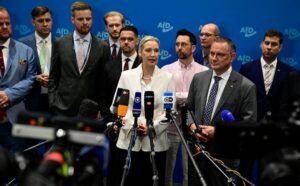
Germany’s far-right Alternative for Germany (AfD) has called on other political parties to work with it after securing a historic victory in the eastern state of Saxony-Anhalt, putting the country’s long-standing political “firewall” against the party under renewed pressure.
The AfD won 43.8% of the vote and 39 of the 83 seats in Sunday’s state election, its strongest performance in any German regional election and almost enough to govern alone. The result puts the party within striking distance of forming Germany’s first far-right state government since the Second World War.

AfD leaders said the result represented a clear mandate from voters and argued that other parties should respect the democratic choice.
The party’s leading candidate in Saxony-Anhalt, Ulrich Siegmund, has indicated that he intends to reach out to other lawmakers in an effort to build a governing majority. The AfD, however, fell short of the 42 seats required for an outright majority.
“We have an outstretched hand,” the AfD’s leadership has signalled, as it seeks to test whether the political barriers preventing cooperation with mainstream parties can be broken.

The election has immediately reignited a major debate in Germany over the so-called “firewall” the long-standing refusal by mainstream parties to form coalitions or formally cooperate with the AfD.
German Chancellor Friedrich Merz’s Christian Democratic Union (CDU) suffered a major setback, winning only about 17.3%, while Merz described the result as deeply shocking. He has nevertheless maintained that the CDU will not cooperate with the AfD.
The political dilemma is particularly acute in Saxony-Anhalt because the AfD’s large lead makes it more difficult for the remaining parties to construct an alternative governing coalition.
The smaller BSW party, which secured enough votes to enter the state parliament, has shown some openness to cooperation, although the situation remains fluid.
The result represents a dramatic increase in support for the AfD, which won just 20.8% in the previous Saxony-Anhalt election in 2021. Turnout this time reached 77.8%, indicating strong voter engagement.

The party has built much of its support around opposition to immigration, criticism of Germany’s political establishment and economic grievances, particularly in parts of eastern Germany.
Its success has triggered concern among Germany’s political establishment and European allies, with neighbouring countries watching closely as the AfD seeks to turn its regional breakthrough into wider national momentum.

The party’s leaders are already looking beyond Saxony-Anhalt. AfD co-leader Alice Weidel has said the party is targeting 40% support at the next federal election, scheduled for 2029.
With further state elections due later this month, Sunday’s result could prove to be a turning point for German politics, and a major test of whether the country’s traditional parties can maintain their refusal to cooperate with the far right.