
World News
Boeing-Lockheed Rocket Fails Mid-Flight, Destroying 40 Amazon Satellites


A Vulcan rocket operated by United Launch Alliance (ULA), a joint venture between Boeing and Lockheed Martin, has failed shortly after launch from Florida, destroying all 40 Amazon Leo internet satellites it was carrying.
The incident occurred on Sunday, November 15, approximately 10 minutes after the rocket lifted off from Cape Canaveral Space Force Station in Florida, marking the first complete mission failure in ULA’s 20-year history.

ULA confirmed the failure in a statement, saying the Vulcan rocket had experienced an anomaly during flight and failed to deliver the Amazon satellite payload into orbit.
“Based on data received by our Launch Director, we confirm that the Vulcan vehicle launched from Space Launch Complex 41 suffered an anomaly 10 minutes into the flight and failed to deliver the Amazon mission to orbit,” the company said.
The cause of the malfunction was not immediately established, with ULA indicating that it would analyse flight data to determine what went wrong.
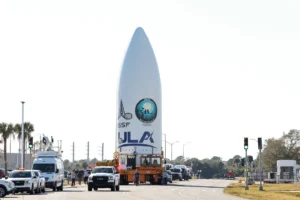
The failed mission was the fifth flight of the Vulcan rocket since its debut in 2024 and its first launch in nine months.
The latest setback follows previous technical concerns involving the rocket’s solid-fuel side boosters and its BE-4 main engines, supplied by Blue Origin, the space company founded by Amazon founder Jeff Bezos.

The rocket’s boosters had experienced anomalies during two previous missions, including a February 2026 flight for the US Space Force. Although those missions successfully delivered their payloads into orbit, the Pentagon had withheld approval for Vulcan to resume national security launches pending further technical reviews.
It remains unclear whether the BE-4 engines contributed to Sunday’s failure. Initial information suggested that the anomaly occurred after the rocket’s second stage separated from the first-stage booster.

Amazon also acknowledged the risks associated with rocket launches, describing the incident as a setback while expressing confidence that ULA would learn from the failure.
The loss of the 40 satellites represents another challenge for Amazon’s Leo satellite internet project, which aims to establish a global broadband network capable of competing with SpaceX’s Starlink service.

Before Sunday’s incident, Amazon had deployed 398 Leo satellites through 14 launches since 2025, representing approximately 12 per cent of its planned constellation of 3,236 satellites.
The company had hoped to begin initial internet services in 2026, but repeated launch delays and technical setbacks have complicated its deployment schedule.
SpaceX currently maintains a significant advantage through its Starlink network, which has more than 11,000 satellites in orbit and millions of customers worldwide.

The failure could also affect the wider US space-launch industry, as an extended grounding of Vulcan would further limit available launch capacity for commercial and government missions.
A comprehensive investigation is expected to determine the cause of the failure and establish what corrective measures will be required before Vulcan can return to flight.