
World News
OPEC Lowers 2026 Oil Demand Growth Forecast Despite Crude Prices Above $100

The Organization of the Petroleum Exporting Countries (OPEC) has sharply lowered its forecast for global oil demand growth in 2026, cutting its projection for the fifth consecutive month as the war involving Iran and disruptions to international energy trade weigh on the global economy.


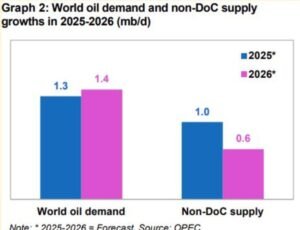
In its latest monthly oil market report released Thursday, OPEC said it now expects global oil demand to grow by just 380,000 barrels per day (bpd) in 2026, down from its previous forecast of 580,000 bpd.
The latest revision represents a significant shift from earlier expectations for the year and highlights the growing impact of the prolonged geopolitical crisis on fuel consumption, economic activity and international trade.
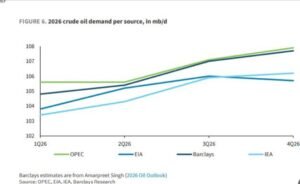
OPEC’s latest revision is the fifth consecutive reduction in its 2026 demand-growth forecast.
The producer group has progressively lowered its outlook as the economic consequences of the conflict have become clearer, particularly through disruptions to oil shipments and higher energy prices.
Despite the latest cut, OPEC remains considerably more optimistic than some other major energy forecasters. The International Energy Agency (IEA) expects global oil demand to decline in 2026, reflecting a substantially weaker assessment of the effect of the conflict and elevated oil prices on consumption.
OPEC, however, expects demand to recover strongly in 2027.
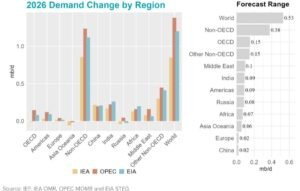
While downgrading its 2026 forecast, OPEC raised its projection for global oil demand growth in 2027 to about 2.36 million bpd, signalling expectations of a substantial rebound once the current disruptions ease.
The contrasting forecasts reflect uncertainty over how long the current Middle East conflict will last and how quickly global trade and energy consumption can recover.
The group has maintained its view that underlying demand for oil remains resilient, particularly in developing economies.
OPEC’s demand revision comes at a time when oil prices are moving sharply higher rather than lower.
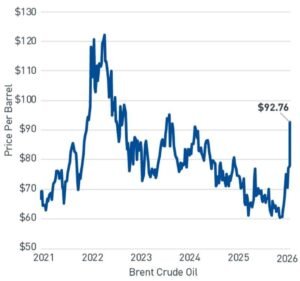
Brent crude surged more than 6% on Thursday, reaching about $107.08 a barrel, while U.S. West Texas Intermediate crude rose above $101 a barrel, according to Reuters.
The jump was driven by escalating attacks on shipping and growing fears of prolonged disruption to oil supplies from the Middle East.
The surge in prices is occurring despite OPEC’s weaker demand outlook, highlighting the unusual conditions facing the global oil market: consumption is expected to weaken, while physical supplies are also being disrupted by the conflict.
The latest OPEC report showed that the group’s oil production was also affected by the regional turmoil.
A Reuters survey found that output from the 11 OPEC members fell by about 640,000 bpd in August to 19.71 million bpd. Disruptions to Saudi Arabian exports and the U.S. blockade affecting Iranian oil shipments were among the factors behind the decline.
Saudi Arabia was particularly affected, with its August production falling sharply as attacks and shipping disruptions complicated exports.
The developments underscore the increasingly complicated situation facing OPEC as it attempts to balance production, market stability and the economic consequences of the conflict.
The Strait of Hormuz remains at the centre of concerns over global energy supplies.

The waterway is one of the world’s most important oil-shipping routes, and disruptions have reduced the flow of crude and other energy products through the region.
The combination of attacks on tankers, restrictions on shipping and military confrontation has pushed traders to price in a greater risk of prolonged supply shortages.
The resulting price increases are already raising concerns about inflation and economic growth in oil-importing countries.
The demand forecast comes just days after seven key OPEC+ countries agreed to maintain their September production levels for October.
Saudi Arabia, Russia, Iraq, Kuwait, Kazakhstan, Algeria and Oman reaffirmed their commitment to market stability during a September 6 meeting and agreed to keep October production at the existing required levels.
The wider OPEC+ group is scheduled to continue reviewing market conditions, with another meeting planned for October 4.
For consumers and governments around the world, the latest OPEC forecast adds another layer of uncertainty to an already volatile energy market.
If high oil prices persist while demand weakens, economies could face the difficult combination of slower growth and renewed inflationary pressure.
For OPEC, the challenge is becoming increasingly complex: the group is confronting weaker expected consumption at the same time that war and shipping disruptions are restricting the physical supply of crude.