
International
Francis Halzen Wins 2026 Nobel Physics Prize for IceCube Neutrino Research

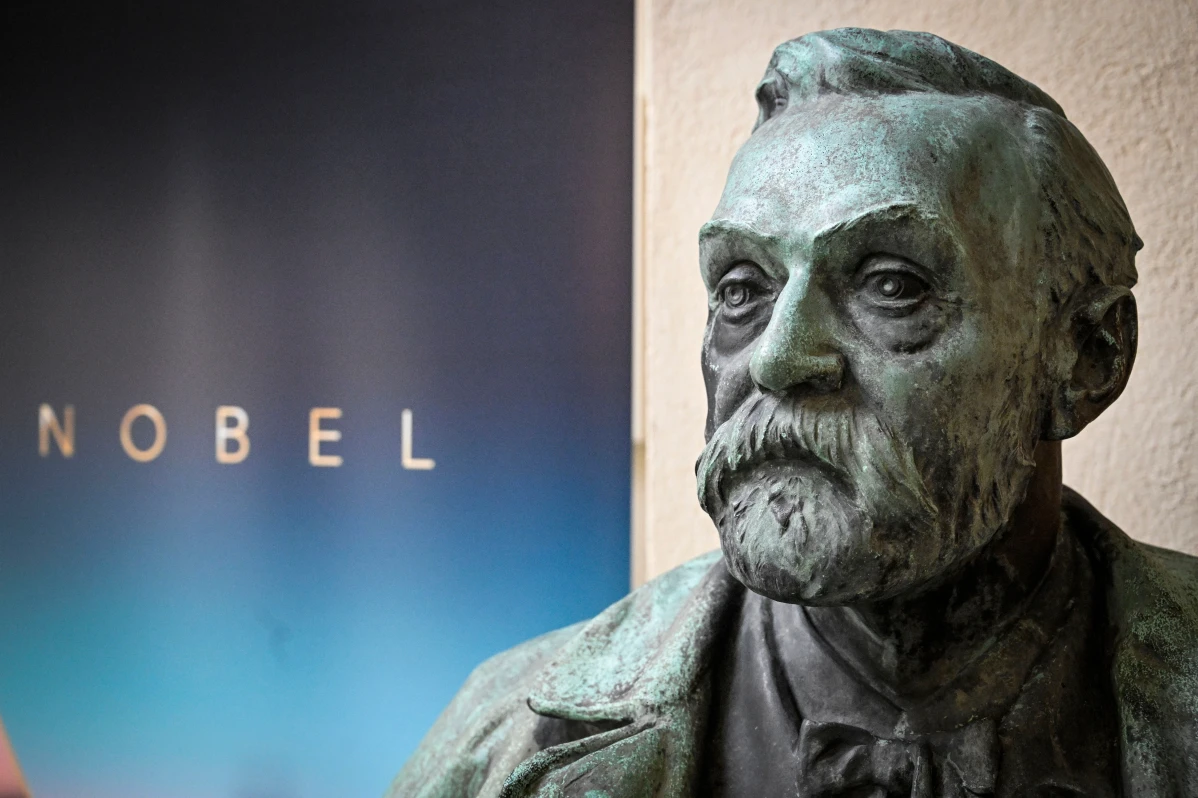
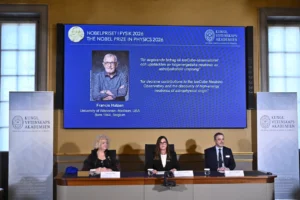
Belgian-American physicist Francis Halzen has won the 2026 Nobel Prize in Physics for his decisive contributions to the IceCube Neutrino Observatory and the discovery of high-energy neutrinos of astrophysical origin.
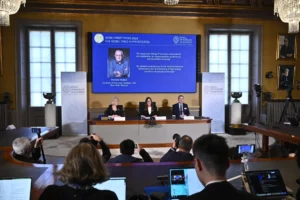
The Royal Swedish Academy of Sciences announced the award on Tuesday, October 6, recognising Halzen’s pioneering work in using the Antarctic ice at the South Pole to detect neutrinos arriving from distant parts of the universe.
Neutrinos are extremely small, electrically neutral particles that rarely interact with matter. Their ability to pass through enormous amounts of material makes them valuable tools for studying violent events and environments across the cosmos.
Unlike light, which can be absorbed or scattered on its journey through space, neutrinos can travel vast distances largely undisturbed. Scientists can therefore use them as messengers from some of the universe’s most energetic phenomena.
Halzen, a professor at the University of Wisconsin-Madison, has led the IceCube project since its early development. His work helped establish the idea of turning a huge volume of Antarctic ice into a particle detector capable of identifying these elusive cosmic particles.
The IceCube observatory is located at the geographic South Pole. Its detector consists of thousands of optical sensors embedded deep beneath the Antarctic ice, where they search for tiny flashes of light produced when neutrinos interact with matter.
The project grew from the earlier AMANDA experiment, with IceCube construction beginning in 2004. The final detector string was lowered into the ice in December 2010, and its first fully instrumented physics run began in 2011.
IceCube subsequently detected high-energy neutrinos originating beyond the Milky Way, providing evidence that the universe contains powerful cosmic accelerators capable of producing particles at energies far beyond those generated by conventional particle accelerators on Earth.
The observatory has also helped researchers identify potential sources of high-energy neutrinos, including active galaxies powered by supermassive black holes.
The Nobel recognition comes after decades of work by Halzen and an international scientific collaboration. IceCube now involves more than 450 researchers from institutions across 14 countries.
The University of Wisconsin-Madison professor began working on the IceCube project in 1987 after arriving at the university from Belgium. His career has focused on the intersection of particle physics, astrophysics and cosmology.
Halzen had already received numerous scientific honours for his work. In 2025, the American Physical Society selected him for its 2026 Medal for Exceptional Achievement in Research, recognising his contributions to neutrino astrophysics, leadership of IceCube and the discovery of high-energy astrophysical neutrinos and their sources.
The Nobel Prize comes with a monetary award of 12 million Swedish kronor, approximately $1.2 million. The formal Nobel ceremony is scheduled for December 10 in Stockholm.
Halzen’s award places neutrino astronomy at the centre of this year’s physics recognition, highlighting how particles that pass almost invisibly through matter can provide scientists with a new way of observing and understanding the universe.