
World News
Trump Signs Executive Orders to Build Powerful U.S. Quantum Computer by 2028

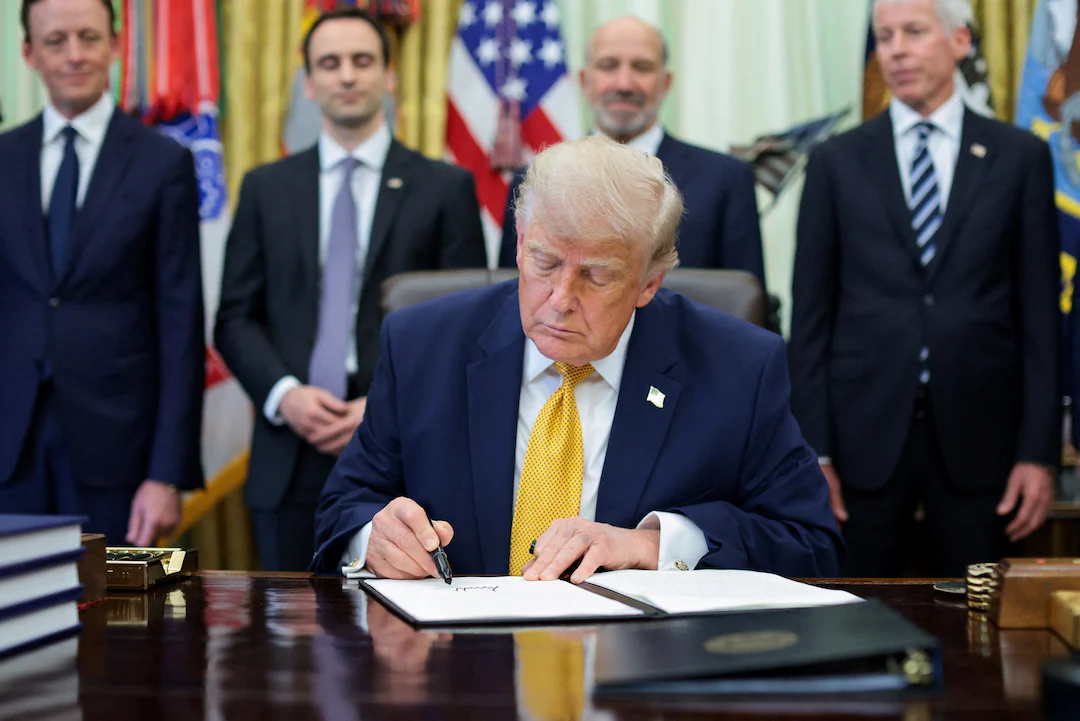
U.S. President Donald Trump has signed two executive orders aimed at accelerating America’s quantum computing capabilities, setting an ambitious target of developing a powerful quantum computer by 2028 while strengthening government defenses against future quantum-powered cyber threats.
The executive actions are designed to bolster U.S. leadership in the rapidly evolving field of quantum technology, an area increasingly viewed as critical to national security, scientific research, artificial intelligence, and economic competitiveness. White House Office of Science and Technology Policy Director Michael Kratsios said the administration believes the goal of producing a powerful quantum computer by 2028 is achievable.
Quantum computers operate using principles of quantum physics, enabling them to perform certain complex calculations far faster than traditional supercomputers. Experts believe the technology could revolutionize fields such as drug discovery, materials science, climate modeling, and artificial intelligence. However, it could also threaten existing cybersecurity systems by potentially breaking widely used encryption methods.
To address those concerns, one of the executive orders directs federal agencies to accelerate the transition of critical government systems to post-quantum cryptography; advanced encryption standards designed to withstand attacks from future quantum computers. The administration has set a target of completing the migration for key federal systems by 2030 or 2031.

The initiative also includes plans for the deployment of quantum-enabled sensors and networks within the next five years. According to administration officials, quantum sensors could provide military advantages by helping aircraft navigate in environments where GPS signals are unavailable or disrupted. The technology could also assist in detecting underground facilities, tunnels, and missile silos from space.
The orders come amid growing competition between the United States and China in emerging technologies. Washington has increasingly viewed quantum computing as a strategic priority, with officials warning that leadership in the field could provide significant economic and military advantages. The administration has also emphasized the need to protect intellectual property and strengthen supply chains related to quantum technology.
The federal push follows recent investments by the U.S. government in the quantum sector. Last month, the Commerce Department announced plans to take approximately $2 billion in equity stakes across several quantum-computing companies, including ventures involving technology giant IBM, as part of a broader effort to accelerate domestic development of the technology.

Industry leaders welcomed the announcement, describing it as a significant step toward maintaining American leadership in one of the world’s most strategically important technologies. While experts caution that practical large-scale quantum computers remain a major engineering challenge, the administration’s 2028 target signals a determination to move faster than many current industry projections.
As governments and technology companies worldwide race to unlock the full potential of quantum computing, the United States is positioning itself to remain at the forefront of a technological revolution that could reshape science, security, and the global economy for decades to come.