# Tags

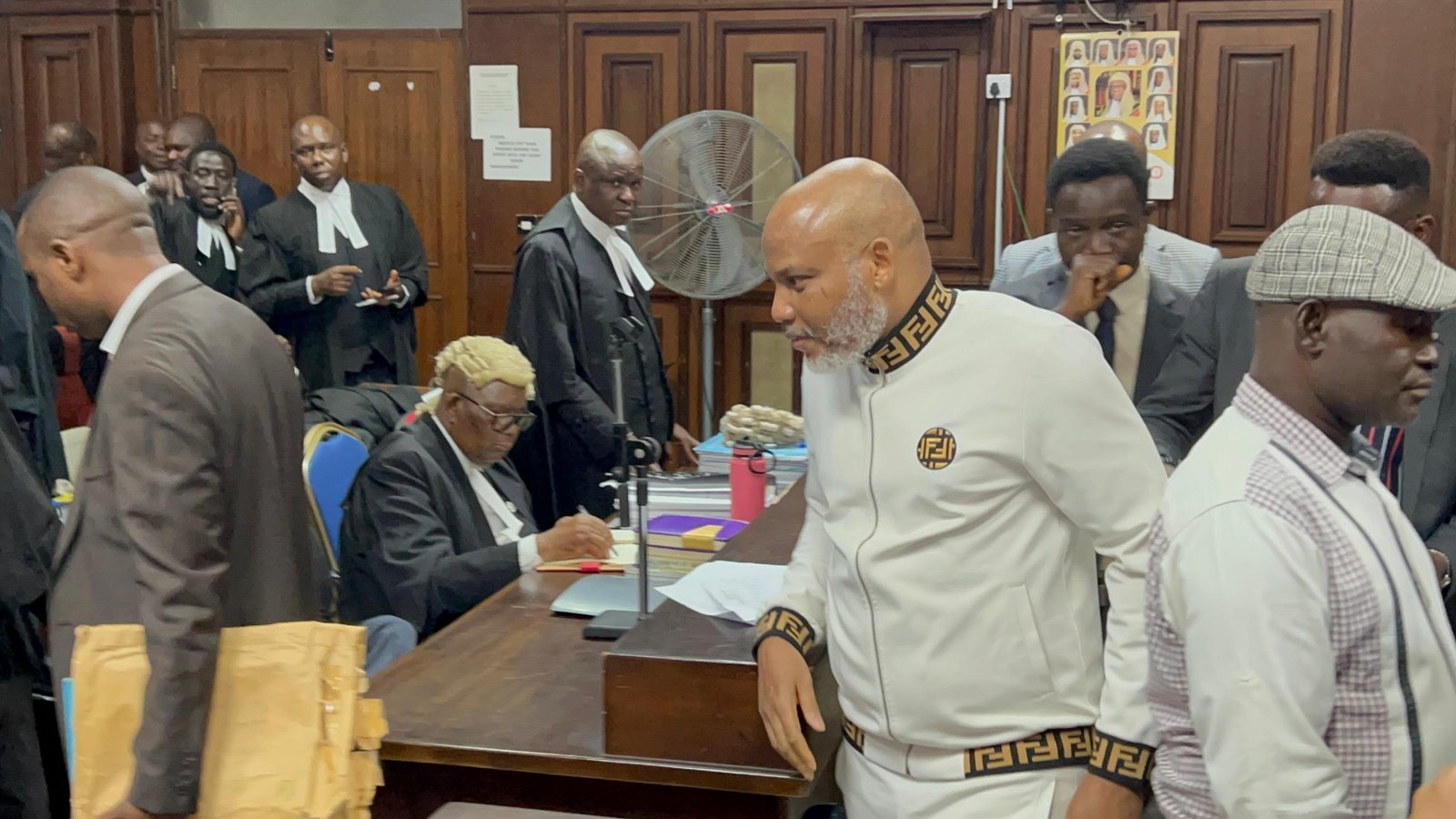
NNAMDI KANU DECLINES TO OPEN DEFENCE, INSISTS NO CASE AGAINST HIM

Nnamdi Kanu, the leader of the proscribed Indigenous People of Biafra, has declined to open his defence in the case brought by the Federal Government. Kanu, who had previously indicated plans to call high-profile witnesses, made the announcement during Monday’s proceedings before Justice James Omotosho at the Federal High Court in Abuja. After finally receiving and reviewing his case file, Kanu stated he found no basis for the charges against him. He therefore requested one week to file a written address instead of calling witnesses. The lead prosecutor, Adegboyega Awomolo, SAN, strongly opposed the request. Awomolo argued that the court had already granted Kanu six days to conclude his defence, two of which had been lost. He insisted the case could not be allowed to drag indefinitely, stressing that the defendant had been fully aware of the charges since his plea was taken and witnesses were cross-examined. The lead prosecutor urged the court to treat Kanu’s refusal to open his defence as the conclusion of the matter and to adjourn for judgment. Justice Omotosho, however, cautioned Kanu about the implications of representing himself, describing him as a “layman” in legal practice. The judge advised him to seek guidance from persons knowledgeable in criminal law. The court also reminded Kanu that the issue of his extraordinary rendition from Kenya had already been settled and was no longer relevant to the trial. In the interest of justice, Justice Omotosho granted Kanu’s request and adjourned the case until Tuesday, November 4. The court will then hear either the opening of his defence or the adoption of his written address on his argument that the government has no case against him.

GLOBAL FERTILITY RATES IN ABYSMAL PLUMMET AS COUPLES STRUGGLE TO AFFORD CHILDREN

A new report by the United Nations Population Fund (UNFPA) has warned that hundreds of millions of people worldwide are unable to have the number of children they want due to the prohibitive cost of parenthood and lack of a suitable partner. The report, which surveyed 14,000 people in 14 countries, found that one in five respondents said they hadn’t had or expected they wouldn’t have their desired number of children. According to Dr. Natalia Kanem, head of UNFPA, “The world has begun an unprecedented decline in fertility rates. Most people surveyed want two or more children. Fertility rates are falling in large part because many feel unable to create the families they want. And that is the real crisis.” The survey found that financial limitations were a major barrier to having children, with 39% of respondents citing it as a reason. The highest response was in South Korea, where 58% of respondents said financial constraints prevented them from having a child, while the lowest was in Sweden, where 19% said the same. However, the survey also found that a lack of time was an even bigger barrier to having children. For many couples, balancing work and family life is a significant challenge. Namrata Nangia, a working mother in Mumbai, spends at least three hours a day commuting to her office and back, leaving her exhausted and with limited time to spend with her daughter. “After a working day, obviously you have that guilt, being a mom, that you’re not spending enough time with your kid,” Nangia said. “So, we’re just going to focus on one.” The report’s findings have significant implications for policymakers, who are increasingly concerned about the impact of low fertility rates on population growth and economic development. However, Dr. Kanem cautioned against panicky policies, saying that “we want to try as far as possible to avoid those countries enacting any kind of panicky policies.” Instead, the UNFPA is urging a more nuanced approach to addressing low fertility rates, one that takes into account the complex and varied reasons why people are having fewer children. As Prof. Stuart Gietel-Basten, a demographer at the Hong Kong University of Science and Technology, noted, “We are seeing low fertility, population ageing, population stagnation used as an excuse to implement nationalist, anti-migrant policies and gender conservative policies.”

NIGERIA DECLINES US INVITATION FOR PRESIDENT TINUBU

The Nigerian government has declined an invitation from the White House for President Bola Ahmed Tinubu to make a working visit to Washington, D.C. In a statement signed by Special Adviser to the President (Information & Strategy), Bayo Onanuga the government cited critical domestic priorities requiring the President’s immediate attention. Bayo Onanuga explained that the APC administration has respectfully declined the invitation due to pressing domestic issues. “The All Progressives Congress (APC) administration has respectfully declined the invitation, citing critical domestic priorities requiring the President’s immediate attention,” Onanuga said. Onanuga also highlighted logistical constraints, including the unsuitability of the presidential aircraft for long-distance travel, as a contributing factor to the decision. The Nigerian government remains committed to fostering strong bilateral relations with the United States and looks forward to future opportunities for collaboration. Onanuga emphasized the government’s commitment to bilateral relations, saying Nigeria is eager to work with the US in the future. “The Nigerian government remains committed to fostering strong bilateral relations with the United States and looks forward to future opportunities for collaboration,” Onanuga added. The decision to decline the invitation reflects the government’s prioritization of domestic issues and its commitment to maintaining strong international relations. Onanuga’s statement provides insight into the government’s thought process behind the decision.