# Tags

FCT MINISTER WIKE CRACKS DOWN ON UNAUTHORIZED ROAD NAMING IN ABUJA, SCOLD AMAC CHAIRMAN

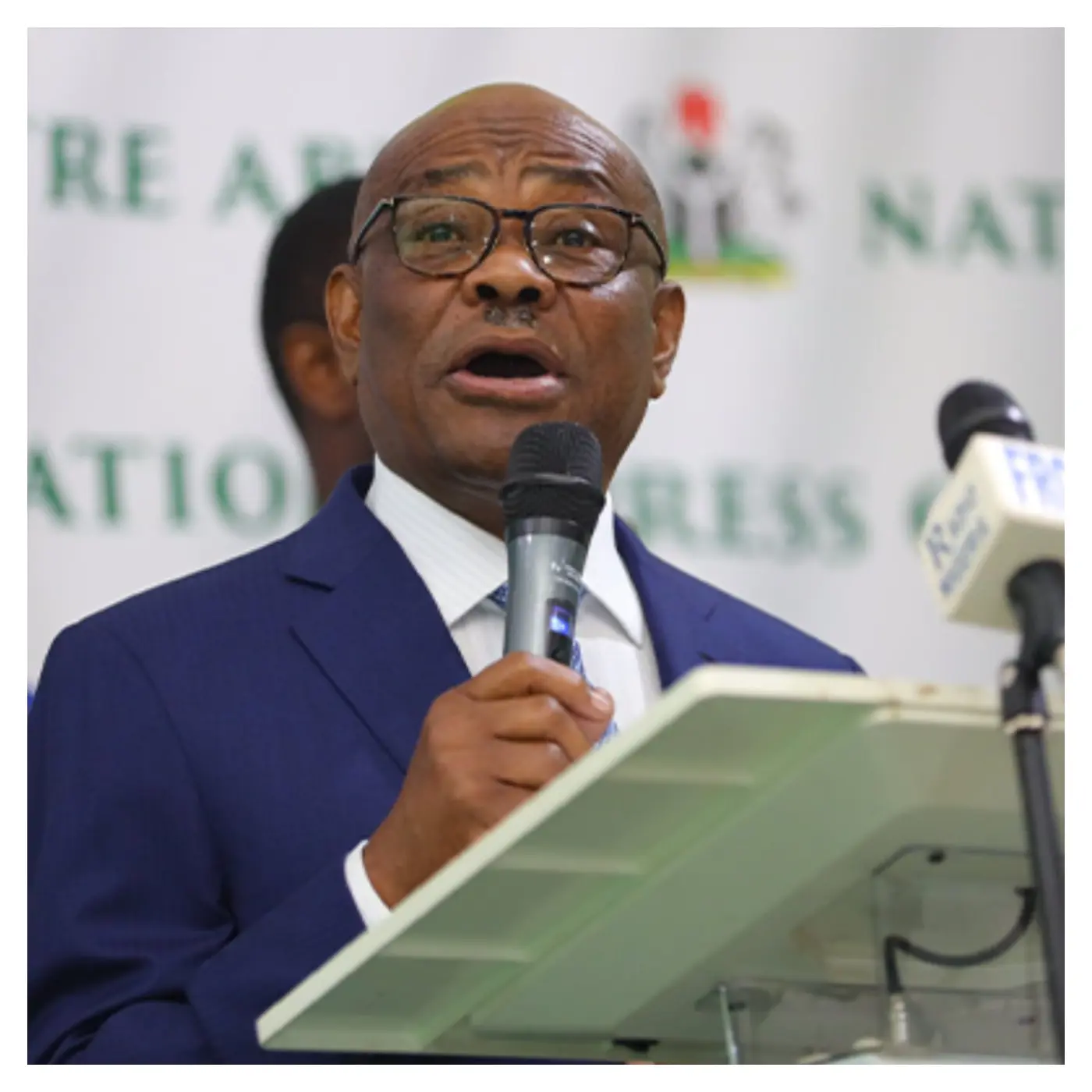
FCT Minister Nyesom Wike has issued a stern warning to Abuja Municipal Area Council Chairman Christopher Maikalangu, instructing him to stop the unauthorized naming of road projects financed by the FCT Administration. The warning was delivered during the flag-off ceremony for the construction of Road A09 in Abuja’s Asokoro area. Wike emphasized the importance of following proper procedures in naming streets, criticizing the practice of naming roads after individuals without his administration’s knowledge or approval. “We cannot be doing roads… before you wake up, you name the streets… on a road we are suffering, looking for money to provide infrastructure,” Wike stated, expressing frustration over the unauthorized naming practices. The Minister argued that road naming should reflect contributions to the area’s development and should not be influenced by monetary exchanges. Wike drew a distinction between satellite towns and the city itself, suggesting that while naming streets in satellite towns might be acceptable, city streets should be reserved for national honors as directed by the President. “We cannot just name roads after people without proper consideration,” Wike’s remarks underscored ongoing concerns about governance and accountability in the naming of public infrastructure in Abuja. The Minister stressed the need for transparency in local government operations, highlighting his administration’s focus on ensuring proper processes are followed in managing FCT-funded projects. Wike’s warning to Chairman Maikalangu reflects efforts to tighten oversight on infrastructure development and naming conventions in Nigeria’s capital territory, emphasizing alignment with broader developmental and national considerations.

WIKE TO COMMISSION TWO ROADS, FLAG-OFF 12 NEW ROADS, LIGHT-UP ABUJA PROJECTS FROM THURSDAY

Minister of Federal Capital Territory (FCT), Nyesom Wike, will commence the flagging-off of construction of 12 new roads and provision of solar lights in major areas of the Federal Capital City (FCC) and Expressways under the Light Up Abuja Programme this Thursday. Senior Special Assistant to the FCT Minister on Public Communications and Social Media, Lere Olayinka, said in a statement on Monday that two road projects will be commissioned while 14 new projects will be flagged-off between Thursday, September 18, 2025, and Thursday, October 16, 2025. Lere Olayinka announced that the Minister will commission access roads in Sector Centre B, Dakibiyu District, and newly constructed Roads ILS 11 (Esther Bali Street) and MAR 24 (Kez Udezue Street) in Mabushi District. One of the projects involves procurement of integrated hybrid solar lighting in Abuja City and Expressway under Light Up Abuja Programme, covering areas like Maitama, Asokoro, Wuse, Central Business District Airport Expressway, Katampe, Garki I and II, Mabushi, Gudu, Jabi, and Katampe Extension. Other projects to be flagged-off by Wike include full scope development of Arterial Road N1 from Wuye District to Ring Road II, construction of Northern Parkway from Ring Road II to Ring Road III, and provision of access road to Bus Terminal at Mabushi District. Additionally, there’s full scope development of Arterial N20 (Solomon Lar Way), access road to Renewed Hope Cities and Estates, and access road bypassing Airport Second Runway with a four-span bridge. Further projects include construction of access road to FCT Fire Service Station, transit way connecting Central Area with Wuse District, Mohammed Isa Road Extension, rehabilitation of 15km old Keffi Road, and engineering infrastructure for Guzape layouts. There’s also construction of Collector Road CN2 (Emmanuel I. Ogala Street) and design of Residences for Heads of Courts. Lere Olayinka noted previous initiatives by Wike, including flagged-off water supply expansion to satellite towns four weeks ago, and construction of a multi-purpose sports centre, new Magistrate Court complex, and Karu road reconstruction two weeks ago.

POLITICS CAN WAIT: WHY INFRASTRUCTURE AND PUBLIC SERVICES MATTER MORE NOW

By Ebiye Odagbor In the heart of every functioning society lies the ability of its government to provide services that meet the daily needs of its people. From roads that link communities to hospitals that care for the sick, the essence of governance is not in lofty rhetoric but in practical, visible delivery. In Rivers State, under the emergency administration of Ibok-Ette Ibas, a new emphasis has emerged, one that centres on infrastructure and basic services as the cornerstone of public legitimacy. At a time when political noise is deafening across Nigeria, the Sole Administrator is sending a quiet but resounding message: politics can wait; governance cannot. The context is crucial. Rivers State, one of the most strategic in the country due to its resources and location, had descended into a political impasse. The declaration of a state of emergency was greeted by scepticism, opposition and legal arguments. Yet, rather than respond with political counterattacks or seek legitimacy through alliances, Ibas chose a different route. He turned inward. He focused on roads, pensions, schools and the daily concerns of citizens who care more about potable water than partisan allegiance. In the first weeks of his administration, attention was immediately given to critical roads in rural and urban areas alike. Many of these roads had been neglected for years. Commuters had grown accustomed to potholes, flooded intersections and the inevitable loss of productivity they caused. But now, the reconstruction of these routes is underway, with contractors mobilised, deadlines communicated and progress monitored. The result is a visible improvement that even the most ardent critics of the emergency government cannot ignore. Beyond roads, the education sector has received similar focus. Dormant schools have been reopened, with furniture supplied and sanitary facilities refurbished. Teachers are being paid regularly, and plans are underway to hire qualified personnel where shortages exist. It is a return to the basics. A recognition that a literate and healthy populace is more important to long-term peace than any political campaign. Perhaps the most symbolic of the recent moves was the historic pension payment of over 2.8 billion naira to hundreds of retired civil servants. For years, these individuals had lived with uncertainty and indignity. To see them receive their entitlements without fanfare or politics, directly into their accounts, was not just administrative action—it was a moral reckoning. It affirmed the principle that governance must be humane. This model of leadership, rooted in service delivery rather than political loyalty, is beginning to redefine public perception. Many in Rivers State who were initially resistant to the emergency structure are now re-evaluating their position. They see the resurfaced roads, the functional schools, the clean-up efforts, the improved waste management systems. They are not being wooed with slogans. They are being convinced with substance. It is important to understand why this matters now more than ever. In a political environment dominated by mistrust, governance often becomes reduced to survival tactics. Leaders are expected to appease factions, reward loyalists and sidestep core public issues until elections loom. But Ibas has departed from this template. He has no political ambition tied to the next polls. He is not beholden to campaign financiers. What he is delivering is the purity of governance untainted by election fever. This makes his model a rare experiment in genuine public service. In many parts of Nigeria, state resources are captured by a narrow elite, while ordinary citizens are asked to endure. What is happening in Rivers now inverts that pattern. The state’s resources are being channelled to visible programmes that benefit a majority. The housing projects are modest but well-planned. Markets are being rebuilt. Small bridges in agrarian communities are being rehabilitated. These are not vanity projects designed to flatter egos. They are evidence of listening leadership. A common criticism of emergency governance is that it lacks accountability. But what Ibas has demonstrated is that accountability is not solely a function of democracy. It is a function of character and orientation. By publicly publishing procurement standards, by insisting that ministries report to the public weekly and by making officials sign performance contracts, this administration is making accountability a culture, not just a campaign promise. It is not all rosy, of course. There are limits. Some projects are behind schedule. The economy remains fragile, and security issues persist in certain rural areas. But what makes this administration stand out is not perfection; it is prioritisation. At every turn, the decision has been to choose what matters most to the people over what pleases the political class. This approach is slowly shifting the conversation across Rivers State. Political actors who had hoped to weaponise public anger are now having to contend with a populace that is seeing results. Civil society organisations that were once antagonistic are beginning to offer praise where due. Even professional unions, known for their sharp criticism, have acknowledged improvements in engagement and delivery. This does not mean that politics is irrelevant. But it does mean that when public service becomes the reference point of legitimacy, politics becomes less toxic. The best politics, after all, is good governance. And the people of Rivers are beginning to witness that truth in real time. Governments rise and fall. Leaders come and go. But the impact of meaningful governance lingers in the roads we travel, the schools we send our children to and the hospitals we trust. If Ibok-Ette Ibas leaves office tomorrow, his legacy will not be a billboard. It will be a bridge, a pension payment, a functioning clinic. The lesson is profound. In a democracy still maturing, and in a region marred by factional fights and economic uncertainty, the true test of leadership lies not in political gymnastics but in administrative focus. The people of Rivers State deserve peace, progress and a government that works. And for now, that is what they are getting. By putting politics on hold and putting service first, Ibas is showing that legitimacy does not have to be argued. It can be earned.

GOVERNOR OKPEBHOLO VOWS TO FIX FAILED ROADS IN EDO CENTRAL

Edo State Governor, Senator Monday Okpebholo, has vowed to fix the failed roads in Edo Central, which he inherited from the previous administration of Godwin Obaseki. The Governor made this known during an inspection of several failed portions of roads across Edo Central Senatorial District. Chief Press Secretary to Governor Monday Okpebholo, Fred Itua, in a statement, quoted the Governor as saying, “Bad roads across Edo State are one of the things I inherited from former Governor Godwin Obaseki and the Peoples Democratic Party (PDP) for eight years they were in power.” Okpebholo assured Edo people that his administration, with the support of President Bola Ahmed Tinubu, will fix the roads. During the inspection, the Governor and his entourage visited Onewa-Udomi-Ibhiolulu-Afada-Idumoza-Eko-Uwaya-Ewora roads, as well as the failed portions at the New Agbor Road and Illushin Road, all in Uromi, Esan North East Local Government Area of Edo Central. Okpebholo stressed the importance of the roads to the economy of Edo State, saying, “This road is very important as it is a link and the gateway between the North and the Eastern part of Nigeria.” The Governor noted that his administration is already in talks with contractors to initiate palliative measures immediately to enable Edo people to use the road. “We are here with contractors to look at the road, get first-hand information to initiate a solution to the road as we need quick intervention to make it motorable,” he said. Fred Itua further quoted Okpebholo as saying, “This is Uromi axis, and the road needs to be fixed to avert any kind of disaster that will cause pains to families.”